804 Day Returns to Shockoe Bottom, Where Richmond is Still Unearthing Its Slave Trade
By Courtney Turrin · July 29, 2026 · 9 min read read
Category: Arts & Culture
Neighborhoods: Shockoe Bottom
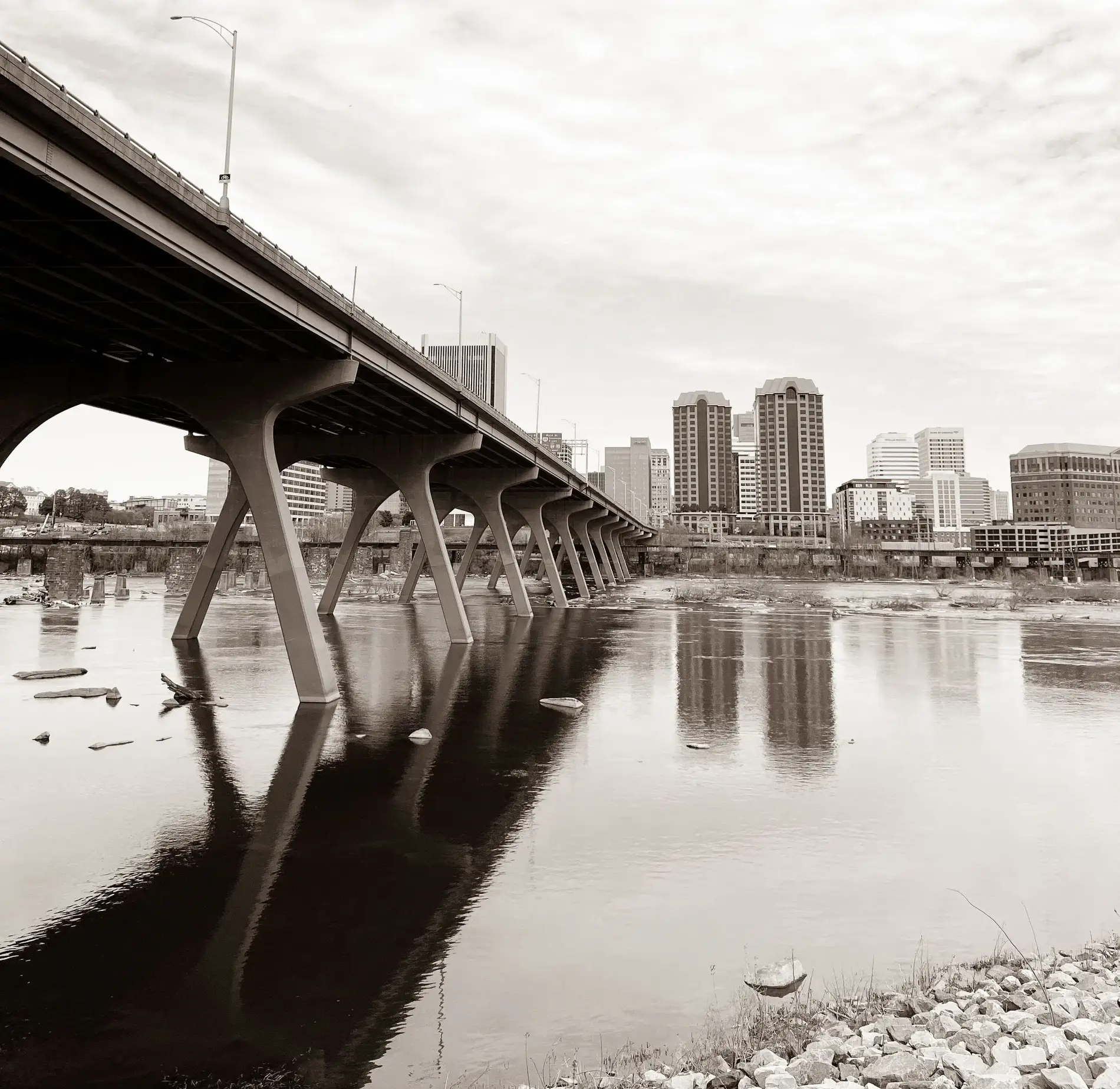
804 Day returns to Shockoe Bottom, celebrating Richmond's culture while acknowledging its history as a major slave trade hub.
Richmond's biggest block party takes over Shockoe Bottom on Saturday. 804 Day runs from noon to 6 p.m. at the 17th Street Market, with local bands, food vendors, artists, and nonprofit booths. New this year, the festival expands onto 18th Street between East Main and East Grace, adding another stage. Admission is free. The name is the area code, and the date is normally the Saturday closest to Aug. 4. This year that lands on Aug. 1.
This is the fourth 804 Day. Shockoe Records launched it in 2023 with 17 performances across four stages, a proclamation from then-Mayor Levar Stoney, and a crowd estimated at 5,000. It has grown every year since, adding stages, vendors, and nonprofits.
The founding description of the event said something that has since dropped out of the coverage. BLKRVA, the Richmond Region Tourism Foundation program that promotes the region's Black cultural experience, listed the first 804 Day in August 2023 using language written for the inaugural year. The block party would be a symbol of love and unity, the listing read, as organizers sought to "shed our slave past" and make Shockoe Bottom an internationally recognized center of creativity.
Four years on, this year's public description reads like any other summer festival listing, a lineup, a new stage, a line about celebrating Richmond's people and culture. What has not changed is the ground itself, and the slave trade that shaped it long before anyone thought to build a block party on top of it.
Why the epicenter of the slave trade was here
Shockoe Bottom is the lowest-lying neighborhood in Richmond, roughly 10 to 30 feet above sea level. That elevation is the reason the city exists. The James River's rapids end near the present-day 14th Street Bridge, and below that point the river turns tidal and deep enough for oceangoing ships. Richmond was founded on that spot in 1737 because it was the last place upriver a vessel could dock, which made it a natural transfer point for tobacco, wheat, and flour moving between the Piedmont and the Atlantic.
One hundred years on, the same navigability served a different commerce. By the 1830s Virginia's tobacco economy was declining after generations of over-farming, and planters shifted toward wheat, which needed fewer hands. Fewer hands meant surplus people to sell. Richmond became the burgeoning nation's primary transfer point for moving enslaved laborers south into the expanding cotton economy. Between 1790 and 1860, somewhere between 850,000 and one million people were forced from the upper South to the lower South. Richmond's was the second-largest domestic slave trade in the country, behind only New Orleans. By 1860 it accounted for roughly half the city's economy.
Fifteen to 25 auction houses and slave jails operated around Shockoe Creek, which now runs underground as part of the city's waste system. Historians still do not know the exact number. Marland Buckner, who leads the Shockoe Institute, describes the business as "vertically integrated," woven through the ordinary commerce of the city rather than confined to a district. Gregg Kimball, the institute's senior historian in residence, has pointed to shops that dressed enslaved people for sale.
The largest of the holding facilities was Lumpkin's Jail, a complex on Wall Street known to 19th-century Black Richmonders as the devil's half-acre. Robert Lumpkin bought it in 1844 and ran it until the end of the Civil War, charging other traders a daily rate to hold people awaiting sale. The city moved its gallows next door. Archaeologists who excavated the site in the 2000s found the jail itself sat about eight feet below the rest of the complex, down a slope from the boarding house where Lumpkin kept his own family. "People inside would have felt hemmed in, trapped," archaeologist Matthew Laird said of the excavation.
After the burials, the robbing
The trade sold living people. It left behind buried ones too, and their graves became a supply chain of their own.
Richmond's Burial Ground for Negroes sat in the Bottom near what is now 15th and Broad. It closed in 1816, when the city opened a new site up the hill, now called the Shockoe Hill African Burying Ground. That site went on to become the largest burial ground for enslaved and free people of color in the United States.
It was also robbed, repeatedly. In 1832 the keeper of the city poorhouse complained to City Council that over six months, "not less than sixteen persons have been disinterred" from the ground set aside for the city's Black residents and paupers. Authorities did not intervene.
The robbing accelerated in 1838, when the medical department of Hampden-Sydney College, later the Medical College of Virginia and now part of VCU, established itself in Richmond. Faculty had chosen the city partly for its supply of bodies. VCU archivist Jodi Koste has said the school had "ready access to patients and also ready access to cadavers," drawing on free Black residents, people without families, and those working for hire in the city.
Medical staff worked with grave robbers, called resurrectionists, and at times did the digging themselves. MCV paid a Black employee named Chris Baker to handle much of it for decades, a role that made him reviled in Black Richmond and celebrated by the white medical establishment. By 1880 the Richmond Daily Dispatch reported that people buried on the hillside near the Hebrew Cemetery generally ended up in the hands of resurrectionists.
The evidence surfaced in April 1994, when construction crews building VCU's Kontos Medical Sciences Building on East Marshall Street uncovered an abandoned well packed with human bone and 19th-century artifacts. Medical staff had discarded the remains there between the 1840s and 1860s, after dissection. Archaeologists got a narrow window to examine the site before backhoes cleared it. The bones went to the Smithsonian.
VCU never filed the report on the discovery it had agreed to file with the Virginia Department of Historic Resources. The university dedicated the Kontos building in 1996 without mentioning the well. The remains sat in storage for two decades until Shawn Utsey, a VCU faculty member, released the documentary "Until the Well Runs Dry" in 2011 and forced the issue back into public view. The remains were returned to Richmond in 2019.
Work on them is still underway. VCU researchers published DNA analysis in February 2026 that established ancestry and physical descriptions for most of the individuals and confirmed the postmortem dissection. Forensic anthropologist Tal Simmons, who worked on the reassociation, said the value was in restoring the individuals' "individualization" after generations as commingled bone. What that meant, in one case, was a woman in her twenties who had given birth, chewed tobacco, and carried heavy loads with her left arm. She still has no name.
In April, VCU's board of visitors voted to spend $3.6 million on a memorial and burial site for them. Construction is expected to begin in the summer of 2027.
Two new memorials in Shockoe Bottom
A few blocks from the 804 Day footprint, the same history is being built into the ground in a different way.
The Shockoe Institute opened this spring in the north end of the Main Street Station, an independent nonprofit running about 10,000 square feet of exhibition and program space. Its building was paid for entirely by an $11 million grant from the Mellon Foundation's monuments project, which Buckner has called the largest privately funded effort of its kind. Its first exhibit, "Expanding Freedom," traces how Virginia codified racial slavery in law starting in 1705.
The institute is the first completed piece of the larger Shockoe Project, a public-private plan to turn 10 acres of the Bottom into a memorial campus. Allocated funding totals about $58 million, combining city capital dollars, a $13.4 million appropriation from the General Assembly, and the Mellon grant.
Its next phase was unveiled two weeks ago. The Lumpkin's Slave Jail Pavilion will be a 21,000-square-foot archaeological and educational center at 1500 E. Franklin St., built directly over the excavated foundation of Lumpkin's Jail, which archaeologists located about 15 feet underground during digs in 2006 and 2008. A below-grade section will expose the foundation itself. The estimated cost is $18 million. Burt Pinnock, the Baskervill principal leading the design, described the site as the thing "that makes it real."
Construction documents are due in the first quarter of 2027, with completion projected 18 to 24 months after that. The full Shockoe Project, which still includes a 62,000-square-foot slavery museum and a set of burial ground memorials, is scheduled for 2037, Richmond's 300th anniversary.
A city still reckoning with its history
The Shockoe Project is one piece of a much longer reckoning, one that reaches back through decades of archaeological work and advocacy and sped up considerably in 2020. Richmond has taken down every Confederate monument it controlled since then. Protesters pulled the Jefferson Davis statue off its pedestal in June of that year, Stoney ordered the emergency removal of the rest of the city-owned statues on Monument Avenue weeks later, the state removed the Robert E. Lee monument in September 2021, and the A.P. Hill statue came down in late 2022, with his remains reinterred in Culpeper.
What replaced the old statues is less settled. A Virginia Museum of Fine Arts effort to lead a community redesign of Monument Avenue folded in 2021, and the city filled the empty circles with mulch and plantings that mostly bypassed public review. Richmond's Urban Design Committee rejected the Lee Circle landscaping in 2022. Four years after the statues came down, the avenue has no long-term plan.
Some of the removed material found a use. The Davis statue now sits at The Valentine, on the site of the studio where it was sculpted in 1903, conserved in the condition it was in when it hit the ground in 2020, pink paint and all.
Meanwhile the Shockoe Hill African Burying Ground remains under pressure. Lenora McQueen, a descendant of a woman buried there in 1857, spent years pushing the city and preservationists toward protecting it, and the site was listed on the National Register of Historic Places in 2022. Proposed highway and rail projects still run at its edges.
On Saturday, several thousand people will stand on 17th and 18th Streets, dancing to live music, drinking local beer, and eating from food trucks. Up the hill, past Main Street Station, the Shockoe Hill African Burying Ground has held its ground since 1816. It survived the grave robbing. It survives the highway plans still drawn at its edges. Two hundred years on, it is still there.