Who's Trying to Change Your Mind About Data Centers?
By Courtney Turrin · June 23, 2026 · 13 min read read
Category: News & Politics
Tags: AI, Data Centers
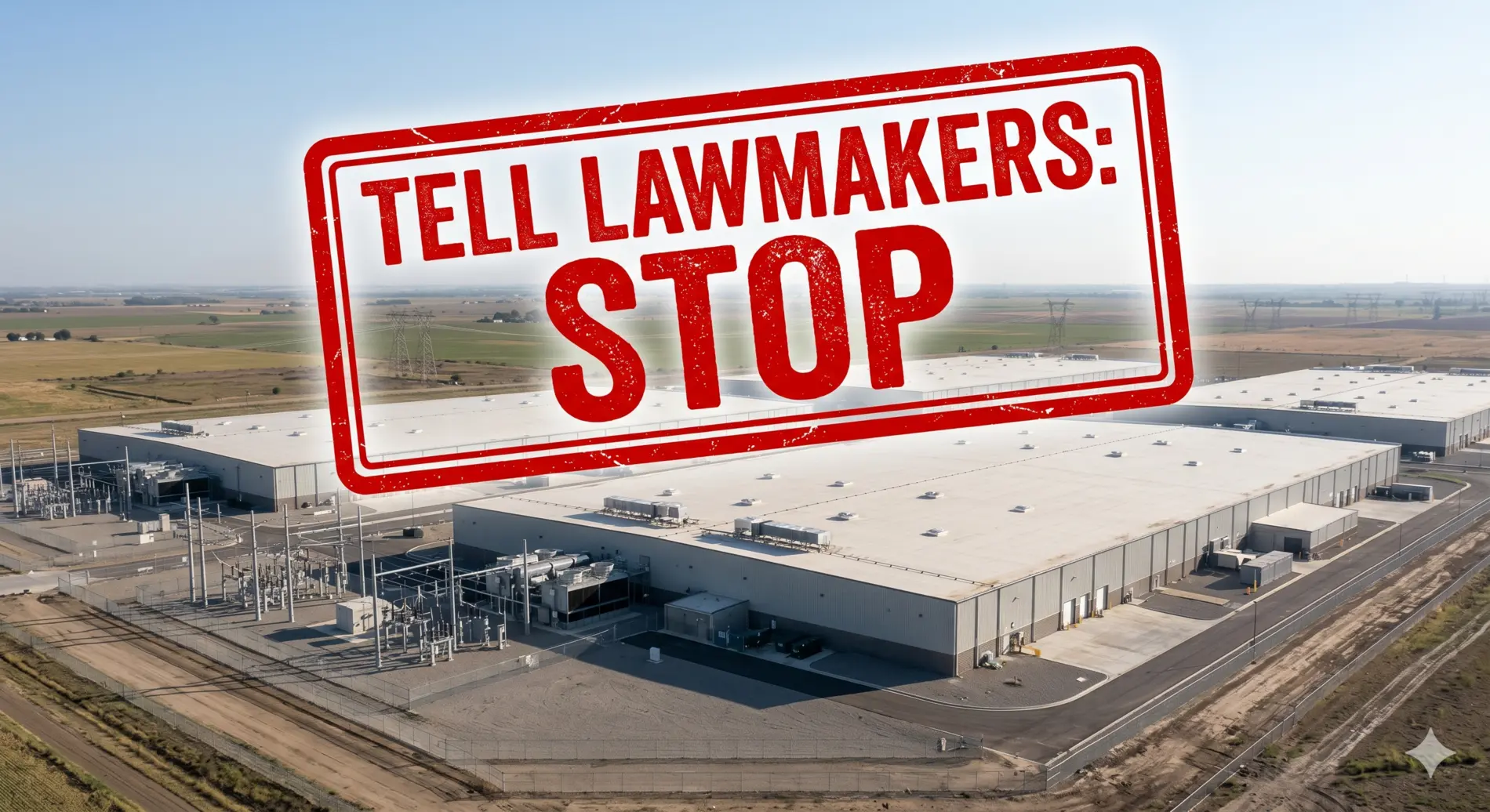
Virginia residents are being targeted by a coordinated campaign to influence the state's biggest budget fight — and not every piece of it identifies who's behind it.
If you've watched YouTube recently, you may have seen the ad. Sweeping aerial shots of solar panels and construction workers, a confident voiceover: "From the birth of a nation to the surge of industry. Virginia has long led the way." If you live in the commonwealth and carry a cell phone, you may also have received a text you didn't sign up for, warning that politicians are pushing "a new tax on digital infrastructure" that will "increase costs on hardworking Virginians."
Both are part of a broader push to shape how Virginians think about one of the biggest policy fights in Richmond right now. Understanding where these messages come from — and what they're leaving out — takes some digging.
Virginia Connects and its backers
The organization behind the YouTube ad is Virginia Connects, a nonprofit describing itself as representing stakeholders who support the essential infrastructure data centers provide. The fuller picture, documented by the Prince William Times, is that Virginia Connects was formed by the Data Center Coalition, a Northern Virginia-based organization of 32 data center developers and owners.
Around Christmas 2024, Virginia Connects ran ads across the state totaling around $700,000. The group's direct outreach to Virginians began even earlier. Prince William County residents received fliers in their mailboxes and cellphone text messages from Virginia Connects, with notices citing the roles data centers play in entertainment, education, healthcare, and business.
Virginia Connects' founding partners include six data center developers and operators — Amazon Web Services, CloudHQ, CyrusOne, Equinix, STACK Infrastructure, and Vantage Data Centers — plus 23 additional organizations, including four chambers of commerce, seven labor unions, and several real estate developer associations. Virginia Connects' founding data center partners have collectively contributed at least $640,000 to the Data Center Coalition's political action committee, according to VPAP, including $250,000 from STACK Infrastructure, $175,000 from CloudHQ, $100,000 from Vantage Data Centers, and $75,000 from Amazon.
Virginia Connects is one branch of a larger advocacy operation. The Data Center Coalition claimed over $4.6 million in revenue in its 2024 tax filing, up from $2.5 million in 2023, and $582,558 in 2022. According to an investigation by Tech Policy Press, the Data Center Coalition has made donations to Virginia politicians through its own political action committee, including $50,000 to House Speaker Don Scott's Democratic leadership PAC, as well as smaller amounts to 34 state lawmakers. Virginia Public Access Project (VPAP) records show the coalition registered lobbyists in Virginia in May 2026, covering all policy issues affecting the data center industry, including energy, siting, and workforce development.
The current YouTube ad, viewed by Channel RVA, opens with the phrase "from the birth of a nation to the surge of industry", a reference to Virginia's colonial-era history used to frame data centers as the next chapter in that legacy. The ad continues: "Virginia's data centers are the engine behind our economy. Creating thousands of good-paying jobs and supporting communities with billions in taxes while powering the breakthroughs that help small businesses hire, startups scale, and industries grow."
The opening phrase shares its wording with the title of the 1915 D.W. Griffith film The Birth of a Nation, which depicted the Ku Klux Klan sympathetically and is widely considered one of the most racist films in American history. There is no indication the ad was a deliberate reference to the film.
What "the digital tax" actually is
The text message and the Virginia Chamber of Commerce video use the same three-word phrase: "stop the digital tax." The Virginia Chamber's ad, posted to its Facebook page and X profile and viewed by Channel RVA, makes the consumer cost argument explicit: "New taxes on digital infrastructure will hit Virginians with higher costs for everyday services like streaming, shopping, software, online services and more. When those costs go up, you pay more. Virginians are already stretched thin, but instead of making life more affordable, politicians in the Virginia Senate are making life more expensive."
The policy they're referring to is real, though the framing deserves context.
Virginia's data center sales and use tax exemption dates to 2008. It currently exempts the industry from paying the 5.3% sales tax on server equipment and software, and the state estimates it forgoes approximately $1.6 billion in revenue per year as a result. In 2025 alone, the industry reported the state waived $1.9 billion in sales taxes. The exemption is currently set to run through 2035. That timeline is a central point of contention. When the legislature created the incentive in 2008, the projected cost to the state was about $1.3 million a year. The difference between that projection and the current $1.9 billion annual figure reflects how thoroughly Virginia's data center industry transformed in the years that followed.
The case for keeping the exemption
Virginia has long positioned itself as one of the most business-friendly states in the country, and the argument for honoring the existing terms of the exemption through 2035 has support from the governor and the House. In a March letter to budget negotiators, Gov. Abigail Spanberger wrote: "I know we share a commitment to protecting Virginia's fiscal integrity, upholding our commitments to businesses that we have invited to invest in the Commonwealth, and maintaining the AAA bond rating we have held since 1938." At an April groundbreaking for a manufacturer of data center computer racks, she said, "The fact that Virginia is a reliable partner matters as much as the incentives we put on the table, and we intend to protect that reputation aggressively."
Keith Martin, interim president and CEO of the Virginia Chamber of Commerce, told NPR that any change "could also call Virginia's reliability as a partner for all industries into question and weaken the Commonwealth's competitive advantage." Over fiscal years 2024 and 2025, data center companies reported investing $80.6 billion in Virginia while claiming $3.2 billion in sales tax exemptions. Proponents of keeping the exemption argue that investment — and the jobs and tax revenue it generates — is contingent on Virginia maintaining predictable policy.
Virginia's legislature retains the legal authority to modify existing statutes, including the 2035 sunset date. The industry's argument is not that changing the terms is legally impossible, but that doing so would damage Virginia's reputation as a reliable partner for business investment.
The case for phasing out the exemption
The Virginia Senate budget proposes phasing out the exemption by Jan. 1, 2027, eight years before its scheduled 2035 expiration, and redirecting the funds into transportation and water infrastructure. As an alternative, the Senate has floated a tiered impact fee projected to raise $582 million in fiscal 2027 and $1.2 billion in fiscal 2028.
Senate Finance Chair Louise Lucas has said her criticism concerns the public cost, not the technology itself. "We are not opposed to technology. We know we all need technology. The problem is, how much will the voters of the Commonwealth — how much are they willing to pay for it?"
The costs senators are pointing to are documented. Virginia's State Corporation Commission approved a Dominion Energy rate increase in November 2025 that will raise the average residential monthly bill by $11.24 in 2026 and by an additional $2.36 in 2027. The SCC noted in its order that the challenges posed by data center growth were "not seen in decades, if ever." JLARC's independent analysis projects that a typical Dominion residential customer could see generation and transmission costs increase by an estimated $14 to $37 per month in constant dollars by 2040, driven primarily by data center demand. Those costs fall on every Dominion customer in Virginia regardless of whether they live near a data center.
On air quality, research published by Virginia Commonwealth University in early 2026 found that data center backup generator emissions in Northern Virginia in some cases exceed those of nearby natural gas power plants. "You'd rather be living next to a natural gas power plant than living next to a whole bunch of data centers, in terms of the total amount of air pollution they put out per year," said Damian Pitt, an associate professor at VCU's Wilder School of Government and Public Affairs, who led the research. Virginia has approved over 9,000 diesel backup generators for data centers statewide. At the time of the VCU study, nearly all of them were lower-standard Tier 2 models, each permitted to run up to 500 hours per year, according to the Virginia Department of Environmental Quality (DEQ). Legislation passed in the 2026 General Assembly session directed the DEQ to stop issuing air permits for generators below Tier 4 emissions standards for new applications after July 2026, a response to growing community health concerns. A full accounting of the documented impacts on electricity costs, water use, land, and air quality is available in Channel RVA's earlier investigation, What Richmond Needs to Know Before It Becomes the Next Data Center Capital.
Who's pushing the message — and who isn't disclosing it
The Virginia Chamber of Commerce is an identifiable institutional actor whose position is publicly stated and whose video is attributed to them by name. The Chamber and dozens of business groups also signed a letter to the General Assembly arguing the Senate proposal would do "significant damage" to one of the state's most economically impactful industries.
The text message received by Channel RVA is a different matter. Sent from a 757 area code covering the Hampton Roads area, it directs recipients to a campaign built on New Mode, a platform that allows anyone to create and deploy political outreach including mass texting. The message included an embedded video — the same ad posted to the Virginia Chamber of Commerce's official Facebook page urging Virginians to contact lawmakers. The text itself carries no disclosure identifying who sent it or who paid for the campaign. Whether it was sent by the Chamber, by another organization, or by a private individual is unknown.
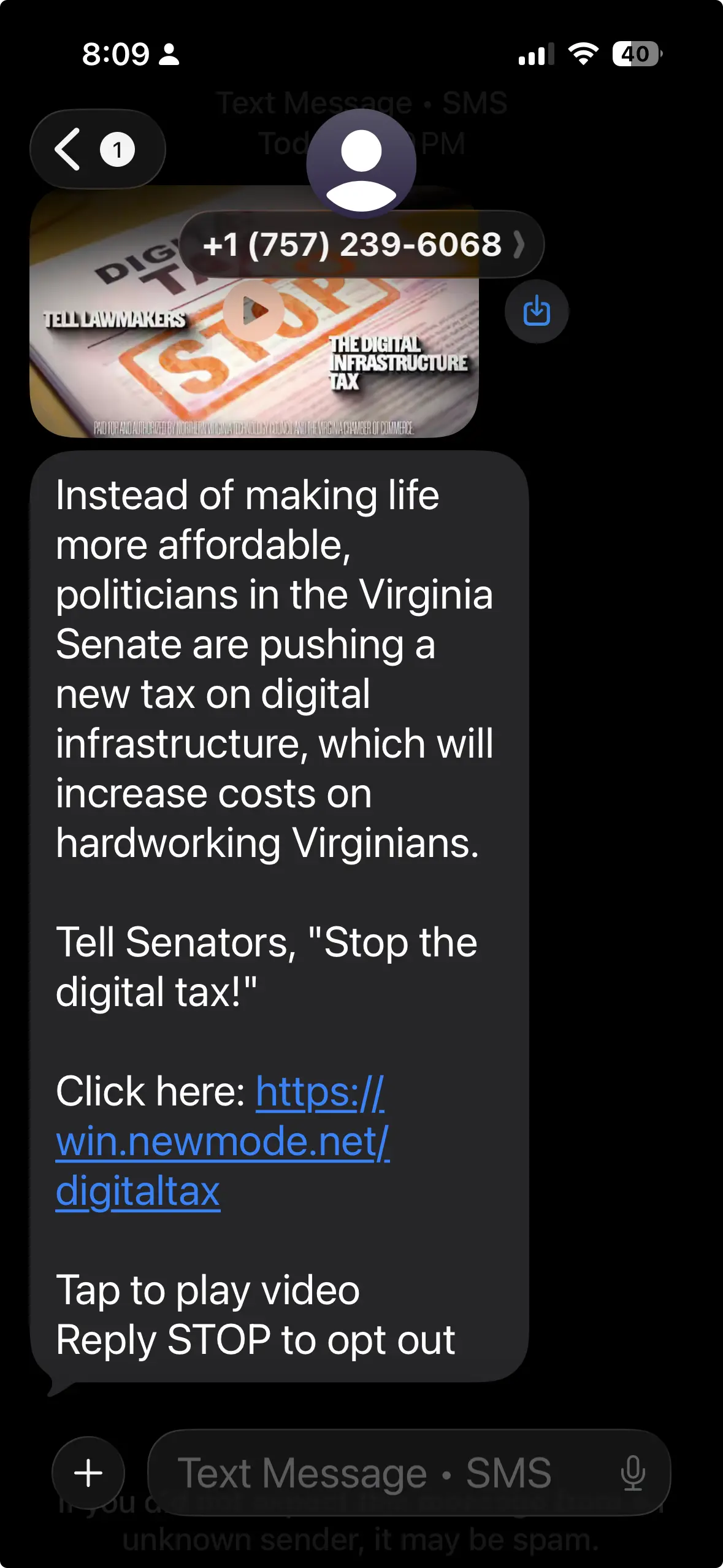
Virginia law requires political advertisers to identify themselves on ads placed on online platforms, with individuals and organizations purchasing or promoting political ads required to certify compliance with state law. Whether a policy-focused text message advocating a legislative position meets the threshold for required disclosure under Virginia law is an unsettled question.
This approach has recent precedent in Virginia. During the April 2026 redistricting referendum campaign, voters received text messages from a northern Virginia area code urging them to vote against new congressional maps. Those messages used a photo from the 1963 March on Washington alongside the text: "Our ancestors fought to represent us. Now Richmond politicians are trying to take our districts away." They carried a disclosure identifying the sponsor as Justice for Democracy. The data center text carried no equivalent disclosure.
Virginia voters approved the redistricting constitutional amendment 52% to 48% in April. The Virginia Supreme Court struck it down in May, finding the legislature had made procedural errors in placing the question on the ballot, and ordered that the state use the same congressional maps as in 2022 and 2024.
Dominion Energy and the money behind the debate
One prominent player in Virginia's data center debate that does not appear in the public campaign messaging is Dominion Energy, the state's dominant electricity provider. Dominion is a major political donor that has contributed directly to the campaigns of both Lucas (over $1.1 million) and House Speaker Don Scott (over $3.6 million), and to Spanberger's 2026 inaugural fund ($100,000). Dominion benefits significantly from data center demand. The utility's own long-range plan calls for billions in new generation and transmission infrastructure to serve data center growth — costs that, under Virginia's regulated utility model, are recovered through customer bills and generate a return for the company.
The campaign finance figures documented through VPAP are substantial. House Appropriations Committee Chair Luke Torian, who has aligned with Spanberger's position on the exemption, has received over $1.8 million in contributions from tech, utility, real estate, and lobbying interests associated with the data center industry since 2020, including over $1.5 million from Dominion Energy alone. Clean Virginia, the clean energy and government accountability group that publicized those figures, is itself a significant political donor, giving $1.6 million to the Jay Jones campaign for attorney general and $1.2 million to Spanberger's gubernatorial campaign in the 2025 cycle, according to VPAP data.
Dominion's position on the broader debate has been notable. When Spanberger amended bills designed to shift energy infrastructure costs from residential customers onto data centers, both the bill's sponsors and Dominion said the amendments weakened the legislation. The General Assembly rejected most of those amendments and sent the original bills back to the governor.
The question being asked nationally
Virginia's data center debate is not happening in isolation. At the federal level, AI-linked super PACs have already spent $43.3 million on congressional races this cycle as the industry works to shape federal AI regulation before midterm elections. Across the country, a recent Gallup Poll found that 71% of Americans somewhat or strongly opposed construction of data centers in their communities. That opposition has prompted a parallel debate about who is driving it.
OpenAI revealed this month that influence operators likely based in China used ChatGPT accounts to push narratives about American AI and technology policy debates, including data center development. House Republicans followed with a letter to the FBI and the President's Council of Advisors on Science and Technology, citing what they called evidence "strongly suggesting" foreign influence campaigns against American data center infrastructure.
Researchers who track foreign influence online are more cautious. OpenAI noted that the operation appeared limited in reach and its social media posts gained little traction. "This was not a case of an influence operation creating a debate. The debate existed already," said Ben Nimmo, who leads threat investigations at OpenAI. Darren Linvill, co-lead of the Media Forensics Hub at Clemson University, said his team has not found significant Chinese activity on this topic. Linvill said, "China tends to care a lot more about what you think about China and China's economy than they tend to do about what you think about your neighbor and what's happening in your own backyard."
The Bitcoin Policy Institute, a right-leaning think tank, published a report in May arguing that Chinese state media and foreign-funded advocacy networks are part of a broader ecosystem opposing American AI infrastructure development. Some who share concerns about AI competitiveness have questioned the tactical upside of tying data center opposition to Chinese influence, noting that much of the resistance comes from local residents with documented concerns about noise, water use, energy costs, and the pace of development in their communities. No evidence has emerged connecting foreign influence operations to Virginia's specific legislative fight over the sales tax exemption.
Virginia's budget deadline is June 30. The exemption question remains unresolved.