Ballots in Mailboxes, Civil Rights Imagery in Flyers: What Richmond Voters Need to Know About Virginia's April Redistricting Referendum
By Billy Briefman · March 10, 2026 · 8 min read read
Category: News & Politics
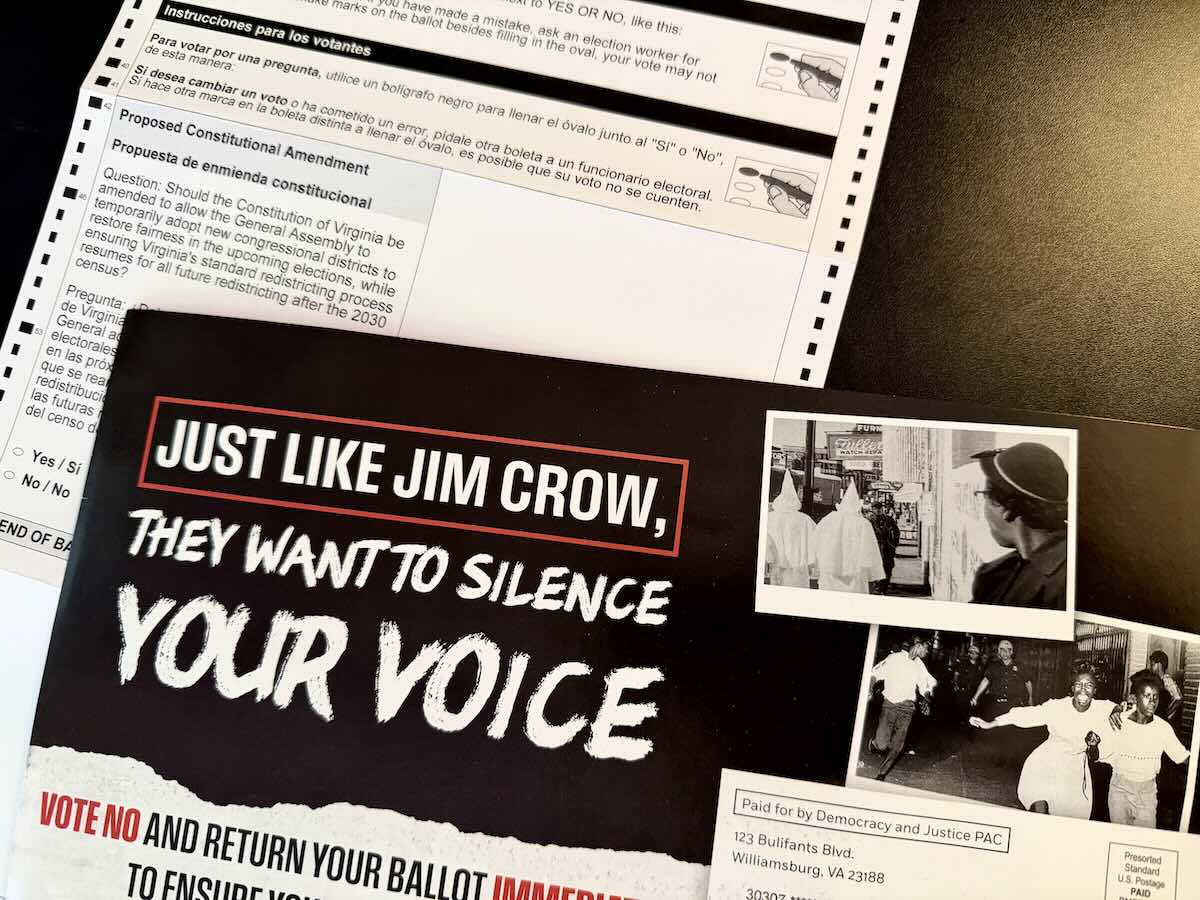
Mail-in ballots have arrived for Virginia's April 21 redistricting referendum. A controversial mailer invoking Jim Crow imagery has drawn bipartisan condemnation. Here's what Richmond voters need to know about the vote, the legal battles, and the national redistricting war behind it.
Mail-in ballots began arriving in Virginia homes this week for the April 21 special election — the only question on the ballot being whether to amend the state constitution to allow lawmakers to temporarily redraw Virginia's congressional districts. The vote has set off a high-stakes political battle playing out at kitchen tables, in state courtrooms, and now in mailboxes across Central Virginia, where a controversial political mailer invoking Jim Crow and civil rights movement imagery has drawn bipartisan condemnation.
Here's what you need to know.
What the Ballot Actually Says
The question on the ballot reads: “Should the Constitution of Virginia be amended to allow the General Assembly to temporarily adopt new congressional districts to restore fairness in the upcoming elections, while ensuring Virginia's standard redistricting process resumes for all future redistricting after the 2030 census?”
A yes vote would allow the Democrat-controlled General Assembly to implement a new congressional map — one that according to Ballotpedia would create a partisan split of 10-1, potentially flipping four of Virginia's 11 congressional seats from Republican to Democratic. Virginia currently has a 6-5 Democratic advantage in its congressional delegation.
A no vote keeps the current system intact. Virginia's bipartisan Redistricting Commission — which last drew maps in 2021 — would retain responsibility for redrawing district lines in 2031 following the next census.
Critically, the amendment's power would expire. Any legislative redistricting authority would end by October 31, 2030, after which the Commission would resume control. Virginia's State Board of Elections confirms the amendment was triggered by a specific legal mechanism: it only applies when another state voluntarily redistricts outside of the standard decennial process — which multiple Republican-controlled states have already done.
Why This Is Happening: The National Redistricting War
This vote doesn't exist in a vacuum. It is a direct response to a wave of mid-decade redistricting in Republican-led states, pushed in part by President Donald Trump.
According to Ballotpedia, as of early 2026, six states — California, Missouri, North Carolina, Ohio, Texas, and Utah — had already implemented new congressional maps between election cycles. Before 2025, only two states had voluntarily conducted mid-decade redistricting in the past 50 years.
Texas was the flashpoint. In 2025, Texas Republicans redrew their congressional map in a move that national Democrats and voting rights advocates warned would cost Black and Latino communities significant representation. The Brennan Center for Justice concluded the new Texas map could produce what it called an unprecedented reduction in minority electoral power since the Voting Rights Act of 1965.
Virginia Democrats framed their response as necessary counteraction. Del. Rodney Willett, a Henrico Democrat who sponsored the resolution, told the Virginia Independent that he was acting out of concern that Trump administration policies were “effectively disenfranchising Virginia voters.” Gov. Abigail Spanberger signed the proposed map, and the General Assembly passed the amendment twice — a constitutional requirement — before it was cleared to go before voters.
Not everyone in the Democratic coalition was enthusiastic. The amendment bypasses the state's own bipartisan Redistricting Commission, which Virginia voters approved in 2020. Some longtime redistricting reformers supported a “yes” vote anyway, citing the exceptional circumstances of nationally coordinated partisan gerrymandering. As Virginia Mercury reported, one original redistricting commission member publicly backed the effort, saying voters “cannot sit by and do nothing” when other states are rigging maps for partisan advantage.
The Legal Battles
The path to April 21 has been anything but smooth.
A circuit court in Tazewell County initially ruled the amendment unlawful, blocking it from the ballot. Virginia Democrats appealed, and on February 13, the Virginia Supreme Court allowed the referendum to proceed. A second lawsuit challenged the process on other grounds and was also ultimately resolved in favor of allowing the election to move forward, with a court ruling on March 2 that legal battles will continue to be resolved after the vote.
That last point matters: even if voters approve the amendment on April 21, the final legal question of its validity has not yet been settled. A ruling against the amendment post-election could potentially nullify the results.
The Controversial Mailer: What It Says and Who's Behind It
As ballots began arriving this week, so did something else: a political mailer that has drawn widespread outrage across party lines.
The mailer, paid for by a group called Democracy and Justice PAC, features black-and-white imagery reminiscent of 1960s civil rights demonstrations. Bold text across the top reads: “OUR ANCESTORS FOUGHT TO REPRESENT US.” Below, it claims: “NOW RICHMOND POLITICIANS ARE TRYING TO TAKE OUR DISTRICTS AWAY.” At the bottom: “VOTE NO AND RETURN YOUR BALLOT IMMEDIATELY TO ENSURE YOUR VOICE IS HEARD!”
A second piece in the campaign reads: “JUST LIKE JIM CROW, THEY WANT TO SILENCE YOUR VOICE.”
The mailers are paid for by Democracy and Justice PAC, which registered with the Virginia Department of Elections on March 3 and lists its address as 123 Bulifants Blvd. in Williamsburg — the same address used by the Campaign Compliance Center, a firm headed by attorney Christopher Woodfin. The Virginia Mercury reported that Woodfin's law firm has provided legal and compliance services to Republican candidates and committees in Virginia totaling more than $366,000 in recent years.
The public face of the PAC is former Republican Del. A.C. Cordoza, a Black former state lawmaker from Hampton Roads who lost his reelection bid in November 2025. Cordoza was the only Black Republican in the House of Delegates during his two terms. He is listed as chairman of Democracy and Justice PAC and a separate similarly named group, Justice for Democracy. The mailers carry varying disclaimer language between the two groups.
Cordoza defended the campaign. “Richmond politicians have ripped apart majority minority districts in order to increase the number of white representatives from northern Virginia,” he told the Daily Press.
But critics — including from within his own party — pushed back forcefully.
Virginia Attorney General Jay Jones, the state's first Black attorney general, called the mailers “disturbing, shocking, offensive and deceptive.” In a statement, Jones said his parents and grandparents “lived through the reality of Jim Crow in Virginia,” adding: “That history is not a political prop, and it should never be exploited in a misleading attempt to confuse voters.”
The NAACP Virginia State Conference formally condemned the campaign, calling the mailers “manipulative” and the comparison to Jim Crow “reprehensible racist tactics.” The organization declared its support for a “yes” vote on the referendum, arguing the amendment protects rather than diminishes Black voting power.
The case for that position lies in the actual proposed map: according to Ballotpedia, if the amendment passes, the map would give Democrats an advantage in 10 of Virginia's 11 congressional districts — likely resulting in the defeat of several white Republican incumbents, not Black officeholders. Among the Republicans who could lose their seats under the new lines are members currently representing districts with predominantly white constituencies.
Prominent Black Virginia politicians — including U.S. Rep. Bobby Scott and U.S. Rep. Jennifer McClellan — have publicly backed the amendment.
The Bigger Picture: What Special Elections Are Telling Us
Supporters of the amendment point to a broader political argument: that Democrats need every tool available heading into November, given a consistent pattern in recent elections.
Since the start of 2025, according to NBC News, Democrats have flipped nine Republican-held state legislative seats in special elections — while Republicans have not flipped a single Democratic seat. Across the full 2026 election cycle since Election Day 2024, the Democratic Legislative Campaign Committee reports Democrats have flipped 26 seats to Republicans' zero.
Political science analysts are cautiously noting the significance. A Boise State University political scientist writing in The Conversation analyzed 88 special elections since Election Day 2024 and found Democrats outperforming their 2024 margins by historically wide margins. In Virginia's 11th Congressional District special election, for instance, the Democratic candidate won by 50 points in a district President Biden had won by 34 — a 16-point over-performance.
Analysts note, however, that special elections don't always predict general election results with precision. Democrats outperformed in the 2021-24 cycle but still lost the presidential race in 2024.
What Happens Next
Early voting is underway through April 20. Election Day is April 21.
If the amendment passes and the legal challenges are ultimately resolved in its favor, the new congressional map would take effect in time for the November 2026 midterms and remain in place through the 2028 presidential election. After the 2030 Census, responsibility for redistricting would return to Virginia's bipartisan Redistricting Commission.
If the amendment fails or is struck down in court, Virginia's current congressional map — drawn by the Commission in 2021 — remains in place through 2031.
For Richmond-area voters, the practical stakes are straightforward: one ballot question, one decision, with potential consequences for how Virginia's congressional delegation looks for the next four years.
Channel RVA covers Richmond and the surrounding region. To register to vote or find your polling location, visit vote.elections.virginia.gov.