Gabon Protected Iboga for a Generation. Washington Just Placed a $50 Million Order.
By Courtney Turrin · July 22, 2026 · 5 min read read
Category: Health & Wellness
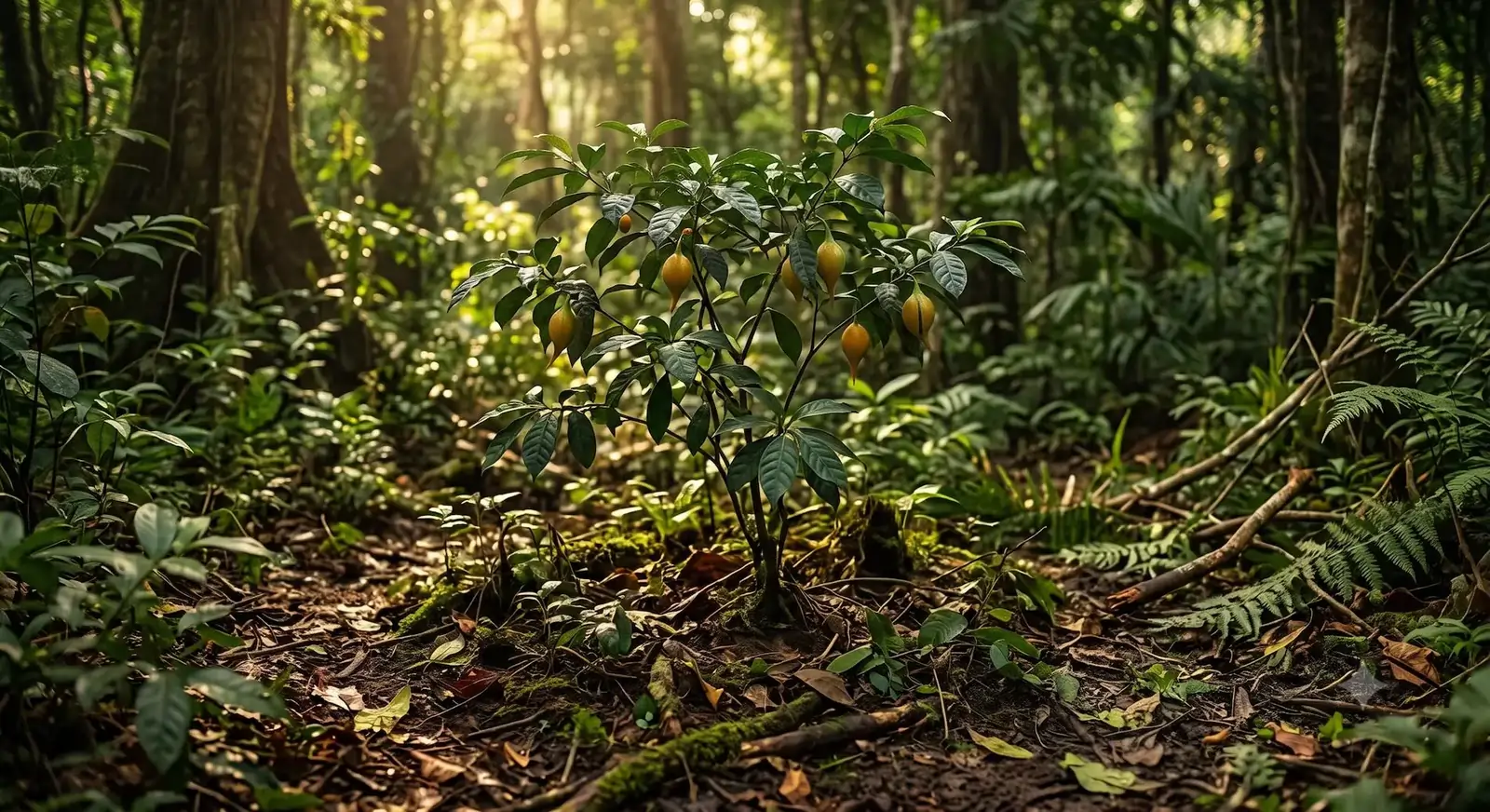
US plans $50 million for ibogaine research, prioritizing the psychedelic derived from Gabon's protected iboga plant.
In the rainforests of Gabon, the root bark of a slow-growing shrub called Tabernanthe iboga holds an alkaloid that Bwiti initiates have used for generations to reach what they describe as contact with their ancestors. On April 18, U.S. President Donald Trump signed an executive order directing federal agencies to speed research and access for psychedelic therapies, and it named ibogaine, the compound in that bark, as a priority. The order commits at least $50 million to the effort. It does not mention Gabon, the Bwiti, or the international agreement Gabon ratified to keep decisions about iboga in Gabonese hands.
Iboga grows in the forest understory across Gabon, Cameroon, and the Republic of the Congo, and its ritual use developed among the Babongo, Mitsogo, and Fang peoples. Within Bwiti, the tradition built around it, the plant serves as both sacrament and rite of passage. Taken in small amounts it acts as a stimulant that suppresses hunger and fatigue. In the large doses used for initiation it produces a waking-dream state that can last more than a day.
Western interest in the plant is neither recent nor American in origin. A purified form of ibogaine sold in France as Lambarène, marketed as a stimulant and mild antidepressant, from 1939 until around 1970. The addiction application traces to 1962, when Howard Lotsof, a 19-year-old dependent on heroin, found that a dose erased his withdrawal symptoms, an experience that turned him into a lifelong advocate and patent holder. The compound also carries documented danger. Ibogaine has been linked to more than 30 deaths in the medical literature, most tied to cardiac arrhythmia, which is why supervised programs build in heart monitoring.
Access opened elsewhere well before the current wave of U.S. attention. Ibogaine has been available by prescription in New Zealand since 2009, entered Canada’s prescription drug list in 2017, and can be prescribed for drug dependence in Australia and South Africa. In Brazil, where it is neither banned nor controlled, a physician began treating addiction patients with it in 1997 and had reached more than 1,500 people by 2020.
Gabon spent the last quarter-century building a legal framework for this moment. In 2000 its Council of Ministers declared iboga a national treasure. It was among the first countries to commit to the Nagoya Protocol, the international agreement requiring that benefits from a nation’s genetic resources and traditional knowledge be shared with the people who hold them, and it did so in large part to protect iboga. In 2019 it halted unlicensed exports, and a Gabonese organization later completed the first legal iboga export under the protocol, the first psychoactive material ever traded under it. Advocates have taken to calling the illegal trade that persists the “blood diamond” of psychedelics.
Gabon is not alone in confronting this. Peyote faces a similar strain as U.S. decriminalization spreads without accounting for the Native American Church or Mexico's Wixárika people, and ayahuasca has drawn comparable scrutiny over tourism-driven demand in Peru and Ecuador. The pattern is the same each time: outside interest moves faster than any framework for the people whose knowledge and land it draws on.
The United States is not party to the Nagoya Protocol. Neither the recent federal order nor the state law that preceded it provides for benefit-sharing with Gabon. Texas seeded the current movement in 2025 with a law that created a public-private consortium to carry ibogaine through the U.S. Food and Drug Administration (FDA) trials and reserved for the state at least 20% of revenue from any resulting intellectual property. That statute names no source community and makes no reference to Gabon or the Bwiti. The group behind both the Texas law and the federal order, Americans for Ibogaine, met Gabon’s forests minister in Libreville in January, though its leadership has publicly pushed back on centering Gabon and the Bwiti in the medical story.
The plant that all of this depends on is barely studied where it grows. The IUCN Red List rates Tabernanthe iboga as of least concern, a status resting on assumed distribution rather than field survey, and researchers note the absence of detailed assessments of its wild populations. The pressures on it, by contrast, are documented. Peer-reviewed conservation work lists overharvesting, deforestation, climate change, and the poaching of seed-dispersing animals among the threats. Forest elephants eat iboga fruit and carry the seeds along their trails, which binds the plant’s reproduction to an animal hunted for ivory. Iboga takes years to mature, and because it once grew abundantly in the Congo Basin, communities never needed to cultivate it, leaving little established farming to absorb a rapid increase in demand. In Libreville’s markets, prices have risen and practitioners who once gathered the bark for free now pay for it.
Twelve days after the U.S. order, Gabon answered. On April 30 its Council of Ministers presented a draft decree declaring iboga and its alkaloid derivatives, ibogaine among them, national strategic heritage, and placing every activity involving the plant, from research to export, under the prior approval of the culture minister and a new interministerial commission. The decree cites both the Nagoya Protocol and a World Intellectual Property Organization treaty on genetic resources and traditional knowledge. Gabonese officials have described plans to build a domestic iboga industry through the country’s sovereign fund rather than watch the value leave with the raw bark.
Whether U.S. demand flows through the framework Gabon has built or around it remains unsettled. Legal, benefit-sharing supply exists, and Gabon is signaling that it wants to expand it. The federal money, the FDA pathway, and the Texas revenue structure describe a research pipeline that can move forward with or without that supply, because the United States is bound by none of the agreements that would require otherwise. By the account of one Gabonese pharmacologist, the West has drawn on the country’s iboga for close to two centuries. Gabon has now written into its own law what it expects in return.