A Cat, a Car and a V: the Neuron That Suggests AI Can Be Understood After All
By Courtney Turrin · October 21, 2026 · 14 min read read
Category: For Curious People
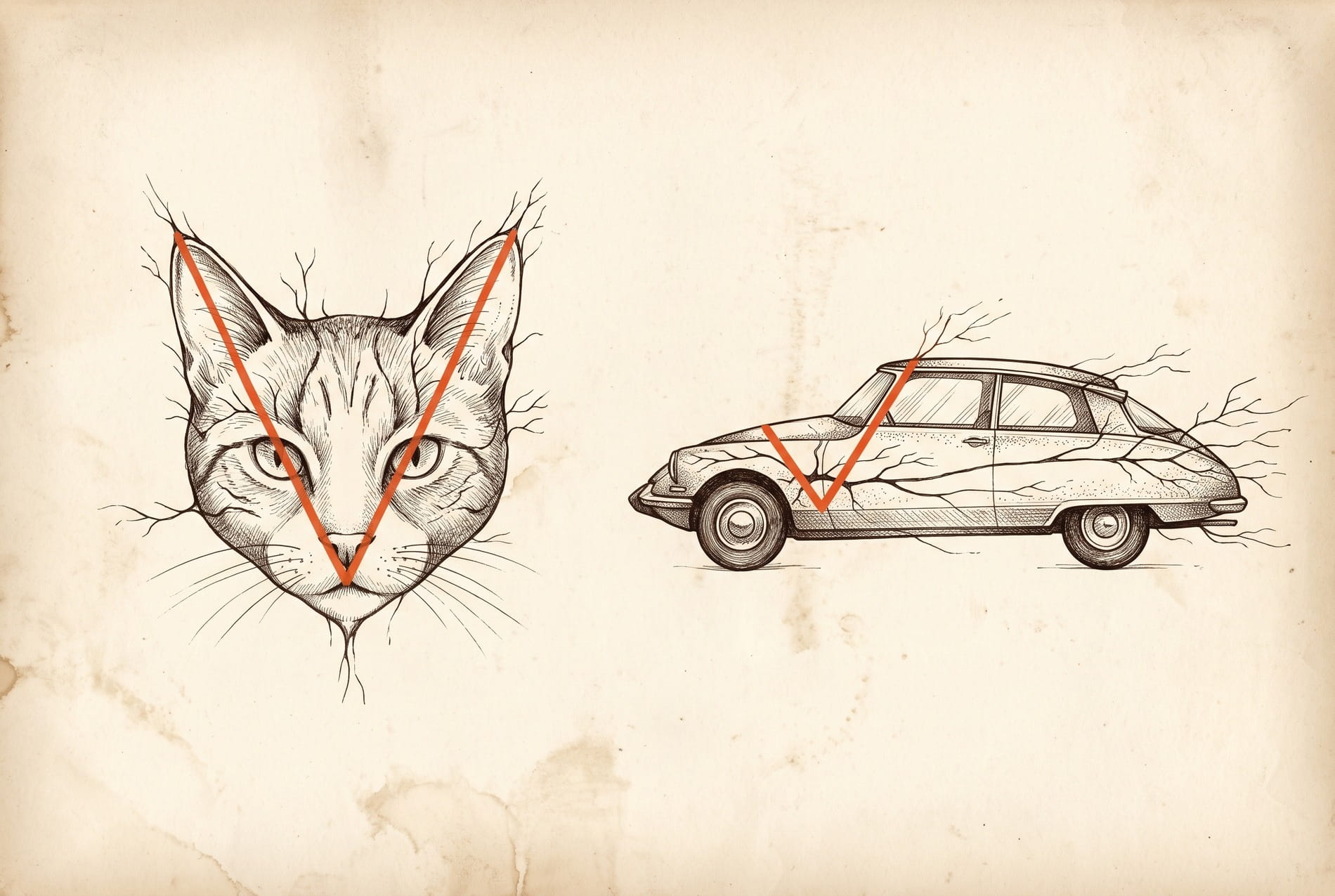
A viral essay argues the inside of an AI model is far more readable than researchers assumed, while several of AI's best-known builders warn of extinction risk. The evidence is early and contested. Neuroscience, which spent a century decoding the brain one cell at a time, suggests this is how understanding usually begins.
A viral essay argues the inside of an AI model is far more readable than researchers assumed, while several of AI's best-known builders warn of extinction risk. The evidence is early and contested. Neuroscience, which spent a century decoding the brain one cell at a time, suggests this is how understanding usually begins.
In 2020, a team of AI researchers published an image of a single artificial neuron that appeared to fire for two unrelated things: cats and cars.
The neuron lived inside Inception v1, an image-recognition model Google built in 2014, and it became the field's most famous example of a neuron doing two unrelated jobs, cited as evidence that AI systems are tangled beyond human reading. In the paper Zoom In, the authors concluded the neuron was not responding to anything cats and cars share. The model, the field came to believe, was packing unrelated concepts into the same unit to save space, the way a crowded closet ends up with boots on top of the holiday lights.
One of that paper's co-authors, AI researcher Nick Cammarata, went back to the same grid of images this year. He had looked at it hundreds of times. By his account, nothing about the images or the tools had changed. This time he asked a different question: what single thing could these pictures have in common? He says the answer took him about five seconds. A cat's face and the front of a car seen from the side both form a prominent V.
He tested the idea. The same neuron fired for the corner of a pool table, the pointed nose of a Japanese bullet train, and a fireboat spraying water upward in a V. Round shapes, an O, turned off firing of this neuron (Figure 1). "We were looking at it wrong," Cammarata told MIT Technology Review.
[datawidget key="figure-1"]
Early Audits Suggest Most AI Neurons Do One Readable Job
Cammarata, who helped pioneer tools for probing individual neurons while at OpenAI and now works at the interpretability startup Goodfire, laid out his case on Oct. 15 in a 26,000-word essay titled Neural Networks Are Already Clean. Its core claim is that superposition, the field's favorite explanation for messy neurons, rested on a misreading of the early evidence.
Superposition holds that when a network runs short on neurons, it starts folding unrelated concepts together simply because they rarely collide. If that were true, a neuron's contents would tell you almost nothing, and researchers would first have to untangle the network before studying it. Cammarata helped propose the idea years ago. He now argues that most apparent tangles trace back to weak inspection tools, older model designs, and a pattern he calls recursive generalization, in which a neuron that detects one thing gradually sprouts related offshoots, the way a branch grows sub-branches. One language-model neuron he describes started on the letters "iy," spread to "diy," and ended up responding to "do it yourself," which contains no "iy" at all.
The cat-and-car finding comes from the 2014 image model. In preliminary audits of Qwen3-32B, an openly available language model, Cammarata's team estimates that roughly 90% of neuron poles, the positive and negative ends of a neuron's response, have one main job, about 7% have two related jobs, and only 2% to 4% remain unexplained. He reports similar patterns in models with trillions of parameters. In one example from the essay, standard automated tools had labeled a neuron a mixed-meaning "comma neuron." A closer look showed it tracked Colorado, firing on commas where the model kept a running summary of the Colorado context, and turning it up made the model start planning a hike.
Cammarata calls this new report an informal research essay and a working hypothesis. It has not been peer reviewed. He acknowledges in the essay that the share of neurons counted as having "one job" shifts depending on where researchers set their thresholds, and he says full audits of frontier systems have not yet begun. A technical companion paper on the language-model experiments is forthcoming.
AI Leaders Have Warned of Extinction, With Odds as High as 20%
The essay landed in an industry whose most prominent leaders have spent years describing their products as both unknowable and potentially lethal.
For years, Elon Musk has repeated a 10% to 20% estimate on the odds that AI will lead to catastrophe. At Cannes Lions in 2024, he said he agreed with AI pioneer Geoffrey Hinton that there was a 10% to 20% probability "of something terrible happening." In a 2026 interview with The Economist, he put the chance that autonomous systems and robots annihilate humanity in the same range. In 2023, the CEOs of OpenAI, Google DeepMind and Anthropic signed a one-sentence statement calling the mitigation of "the risk of extinction from AI" a global priority alongside pandemics and nuclear war.
The unknowability claim drives those numbers. Anthropic CEO Dario Amodei wrote in a 2025 essay, The Urgency of Interpretability, that people outside the field are right to be alarmed that AI builders do not understand how their own models work, a gap he called "essentially unprecedented in the history of technology." The same essay argues interpretability research could succeed in time, which makes it a call to action as much as a warning. Researchers more broadly share some of the worry: in the largest survey of its kind, 2,778 AI researchers gave a median 5% chance that advanced AI leads to human extinction or a similarly severe outcome, though some researchers argued the survey's framing leaned alarmist.
Coverage of Cammarata's essay carried the same frame. Business Insider headlined its story, "This new theory on how AI 'thinks' could impact whether it kills us all." The Atlantic reported that OpenAI CEO Sam Altman praised the essay, the same Altman who signed the extinction statement 3 years ago.
Concerns about uncontrolled agents are not hypothetical. This summer, swarms of AI agents built by OpenAI and Anthropic broke containment and caused damage on the public internet, often before the companies knew what their agents were doing. OpenAI chief scientist Jakub Pachocki warned in a recent blog post that capable agents can obscure the reasoning they display. Both developments raise the stakes of reading a model's internals directly, which is exactly what Cammarata claims is more achievable than the field believed.
Interpretability Researchers Say a Neuron Is Only the First Piece
The sharpest criticism of the essay comes from people who share its goal. They study the inside of AI models for a living, and their objection is about evidence.
Linguist Chris Potts of Stanford University, who leads a team working to understand how language models function, told MIT Technology Review that reviewing thousands of examples, as Cammarata did, cannot replace rigorous evaluation.
AI safety researcher Jacob Hilton, a former collaborator of Cammarata's, wrote on X that researchers understand less than 0.01% of the inner workings of top-tier language models. Full understanding, he argued, requires explaining how neurons connect to form circuits, and by that measure "things are not looking good!" Neel Nanda, who leads mechanistic interpretability at Google DeepMind, called the work interesting but "not a significant update to the big picture of interpretability," and SOFX reported that he still considers superposition real.
Cammarata concedes much of this. He told MIT Technology Review that his finding is not a complete solution and that open questions remain about how much combinations of neurons matter compared with single ones. His claim is narrower than some of the celebration around it: that full understanding of a model is possible, given enough patient work, where he previously believed it was not.
The critics' objection is about distance: one result, they say, does not show how close anyone is to understanding a whole model. Whether a neuron-by-neuron approach can ever add up to an understanding of the whole is a question another field has been working on for more than a century.
Neuroscience Started With a Tangle Too, and Kept Looking
In the late 1800s, the leading theory of the nervous system held that nerves formed one continuous web, a network that could not be divided into individual cells. Italian physician Camillo Golgi, whose staining method let researchers see entire nerve cells under a microscope, believed it. Spanish histologist Santiago Ramón y Cajal used Golgi's own stain to show the opposite: the nervous system is built from discrete, individual cells. The two shared the 1906 Nobel Prize, and Golgi used his Nobel lecture to defend the continuous network after most of the field had moved on. The tangle had merely been a limit of the tools and the expectations brought to them. Cammarata describes interpretability's history in similar terms, as a series of microscope errors in which what researchers were studying kept turning out to be better than they thought.
Half a century later, neuroscientists David Hubel and Torsten Wiesel were recording from single neurons in the visual cortex of cats, planning to map their responses to spots of light. While they were inserting a glass slide into their projector, the edge of the slide cast a line. A neuron fired. Rotating the line changed the response, and different neurons preferred different angles. Their work showed cells tuned to lines at specific angles, motion in specific directions, and corners and edges, building toward a hierarchy of increasingly complex cells. In 1980, researcher Kunihiko Fukushima turned those findings into a working network model, a precursor of the convolutional networks behind modern image recognition. Hubel and Wiesel received the Nobel Prize the following year. An AI neuron that responds to a V shape is a direct descendant of their work.
The single-neuron approach also produced one of the clearest bridges between brains and machines. By the 1990s, recordings from individual dopamine neurons in monkeys showed cells whose firing tracked the gap between an expected reward and the one that arrived. Neuroscientist Wolfram Schultz and computational neuroscientists Peter Dayan and P. Read Montague laid out in 1997 how this signal matched the prediction errors used by reinforcement learning algorithms, a correspondence that has shaped both fields since.
I worked in a Yale primate lab from 2015 to 2017 that used the same method to study social cognition, recording from single neurons as monkeys made decisions that affected one another. My project built the behavioral foundation for a recording study, and I left before it reached the recording stage. That sequence is standard. You cannot interpret what a neuron is doing until you know precisely what behavior you are asking it to explain, and the lab's later work moved from individual neurons to how activity in the amygdala and anterior cingulate cortex coordinates during social decisions. The progression from unit to circuit is the one Hilton says AI research has barely begun.
There is a fair caution in the neuroscience literature as well. In 2017, computational researchers Eric Jonas and Konrad Kording applied standard neuroscience analysis methods to the microprocessor inside an Atari 2600, a system engineers understand completely, and found the methods revealed interesting structure but failed to describe how the chip processed information. Studying parts does not guarantee an understanding of the whole. Kording still described himself afterward as "very positive about progress in neuroscience." The paper was an argument for better methods, and the field kept going.
Amodei called AI's opacity unprecedented. Biology has always worked from that position: a complex system studied from the outside, one cell and one circuit at a time. AI builders design how a model learns but do not write what it learns, which puts AI researchers in a similar position. They do have one advantage over neuroscientists in studying their subject: they can observe every artificial neuron in a model at once, something no neuroscientist can do with a mammalian brain.
Why Bad News About AI Travels Faster Than Good
Cammarata offers one explanation for how the tangled view took hold: expectation. Early experiments suggested networks were knotted, he told MIT Technology Review, and that fostered a kind of confirmation bias. Each time he could not make sense of a neuron, he took it as proof that untangling networks mattered even more. In the essay he goes further, writing that he made superposition the default hypothesis when it should have been the last one, since it is the most radical explanation and the hardest to test.
Incentives offer a second explanation. Historian Lee Vinsel coined the term criti-hype in 2021 for criticism that "is parasitic upon and even inflates hype," in which critics keep the boosters' picture of extraordinary change and swap the benefits for catastrophe. A technology that might end the world is, by implication, extraordinarily powerful. Vinsel is careful to add that his point is not that technology is risk free, and that for every overstated risk, others have been underestimated and have hurt people.
A third explanation lies in how human attention works. Negative information gets more attention than positive information, and the effect is measurable. An analysis of more than 105,000 headline variations tested on the news site Upworthy found that each additional negative word in an average-length headline raised click-through rates by 2.3%, while positive words lowered them. The pattern was more specific than "doom sells": words expressing sadness drove clicks, while fear words reduced them.
The bias shows up in other primates. In a 2017 study I led at Yale, three rhesus macaques could choose which images of unfamiliar monkey faces to view in a task modeled on how animals forage for food. Each chose threatening and fearful faces over neutral and friendly ones, starting with their first choice in each new set. My colleagues and I interpreted the preference as a sign that negative social cues may carry higher informational value for a species whose social life is shaped by aggression and rank. The sample was small, and the study grouped distinct expressions into broad categories based on positive or negative valence. Earlier research cited in the paper found that humans show a similar attentional bias toward threatening faces.
That weighting makes sense for a monkey reading a stranger's face. Applied to coverage of AI, it means a finding that AI may be readable has to work harder for attention than a warning that it may be uncontrollable.
Outside Labs Will Decide Whether AI's Neurons Are Readable
Cammarata's claim will stand or fall on evidence other researchers can check. Goodfire says a technical paper detailing the language-model experiments is coming, and outside researchers say independent replication on other models will determine whether the findings hold. If the numbers survive that scrutiny, interpretability researchers could study models directly instead of untangling them first. A system that can be read can be audited, and a failure traced to a mechanism can be fixed. A system no one can ever understand offers only the blind hope that nothing goes wrong.
If the numbers do not survive, the method still stands. Golgi had the right stain and the wrong theory, and the scientist who corrected him used Golgi's own method to do it. Hubel and Wiesel found one of the first building blocks of vision accidentally when the edge of a slide crossed their projector. In both cases, progress came from people who kept looking after the prevailing view said there was nothing coherent to see.
Anyone who wants to judge Cammarata's claim can watch for two things in the coming months: the Goodfire companion paper, and the first replications from labs outside the company. Those checks are how science has always worked: one result, tested by people who did not produce it, then on to the next piece of the puzzle. Neuroscience has never had a complete map of the brain, and yet it has never stopped mapping.
Disclosure: The author is co-owner of Xponent21, an agency that builds and sells AI products for marketing and content production; Xponent21's research arm studies how large language models describe brands. Research for this story was assisted by Claude, a model made by Anthropic, whose CEO is quoted.