Reading the Patterns: What the Next Decade Builds
By Will Melton · August 15, 2026 · 10 min read read
Category: Opinion
Moore's law, Wright's law, and compressing adoption curves tell us more about the next decade than any prediction could. A pattern-by-pattern walk through energy, fabrication, autonomy, health, education, and the choices Richmond gets to make.
I am insatiably curious. It is probably my defining trait. I read across disciplines, I interview doctors, builders, educators, and civic leaders for my podcast, America's Healthiest City, and for the last four years I have traveled with ChamberRVA to Kansas City, Atlanta, Greenville, and Phoenix to study what made those cities work. When you take in that much information from that many angles, you start to see patterns. And patterns, unlike predictions, have a track record.
I recently wrote about the closing gap between imagination and reality, the recognition that the distance between having an idea and holding the result of it is collapsing. This piece is the companion to that one. If the gap is closing, what does it build?
You don't have to guess at inventions to answer that. You can project patterns that have already played out. Moore's law held for sixty years. Wright's law, which says costs fall predictably every time cumulative production doubles, has held for solar panels, batteries, and genome sequencing. Adoption curves keep compressing: the telephone took 75 years to reach 100 million people, and ChatGPT took two months. Capability doubles, cost falls, adoption accelerates. Run that forward through the systems we live in, and a picture emerges.
Here is what I see. Each section builds on the one before it.
Energy is the substrate
Everything downstream of this paragraph runs on power, so start here. Solar gets the headlines because its cost curve is the steepest in the history of energy, and we will absolutely harvest it at massive scale. The bigger truth is that we are surrounded by untapped flux. Ocean wave energy is dense and predictable in ways wind and sun never will be; you can forecast tides decades in advance. Enhanced geothermal takes drilling techniques perfected over the last twenty years and repurposes them to circulate fluid through hot rock, which means geothermal stops being an Iceland novelty and becomes viable nearly anywhere. Molten salt, thermal brick, iron-air batteries, pumped hydro variants: the storage race is on from a dozen directions at once.
That last part matters most. Generation is becoming abundant. The strategic asset is shifting from the well and the mine to the battery and the grid. Whoever solves storage sells reliability, and reliability is the actual product. Most of the scarcity we lived with in the twentieth century was energy scarcity wearing a costume. Cheap, dispatchable power makes desalination viable, makes recycling economics work, powers the compute behind everything else in this piece.
Making things approaches free
I build digital prototypes in a day. That sentence would have sounded like a boast five years ago; today it is just a description of the tools. The same collapse is now reaching physical goods, and the pattern rhymes with what happened to music. Songs went from pressed vinyl to streamed files. Goods are going from container ships to streamed designs.
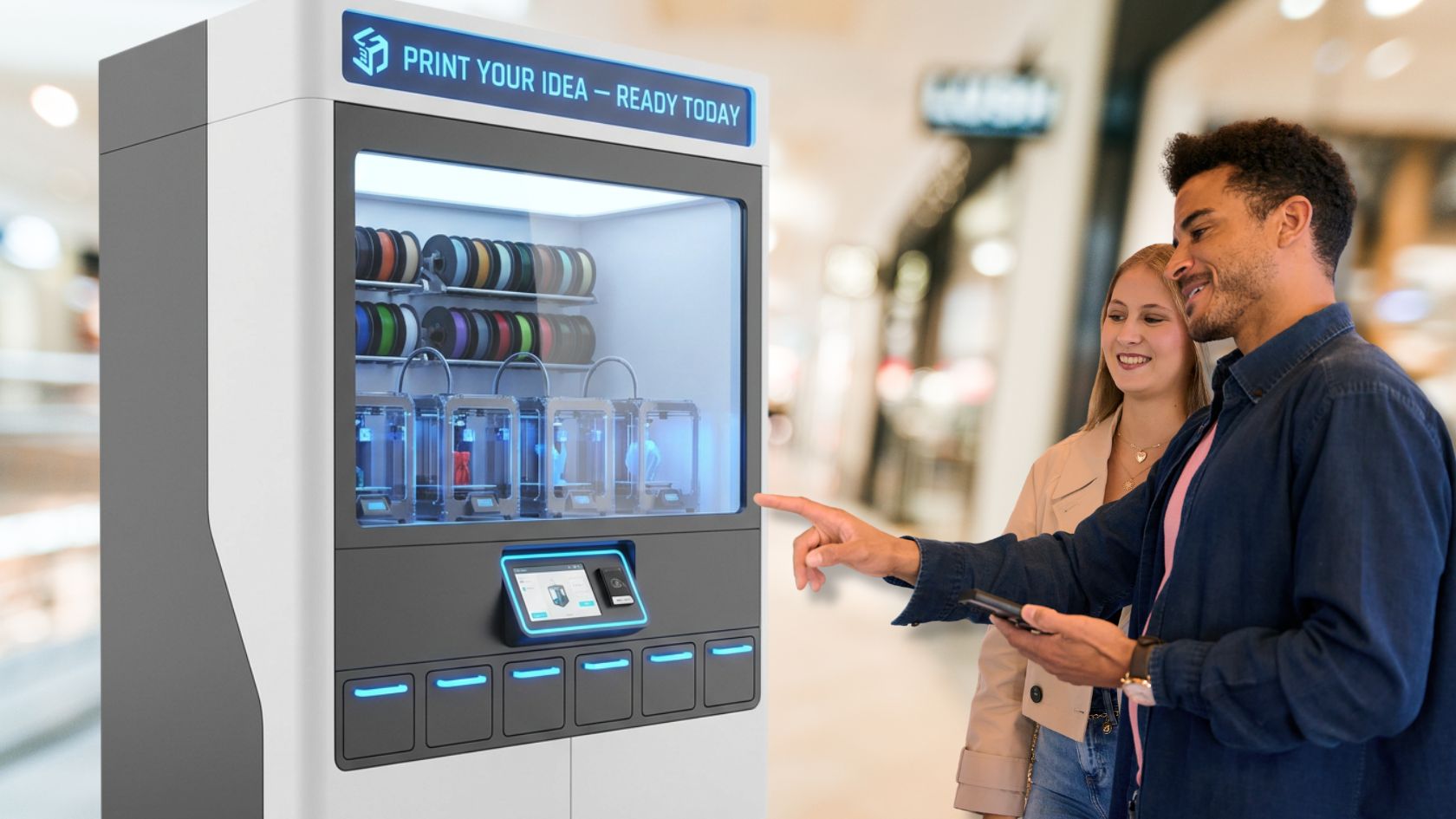
Picture a fabrication kiosk on a walkable street corner. You approve a design over coffee, a bank of printers produces it during the day, and you pick it up on your walk home. Pay a small license to print someone else's design once, or send your own. Circuit boards, machined small parts, replacement components follow the same curve a few years behind. The discontinued bracket that used to kill your dishwasher becomes a forty-cent print, and repair culture comes roaring back.
Notice what this does to retail logistics. The old model moved inventory near people and hoped. The new model moves nothing until it is wanted, then moves it a mile. Which brings up the question of who, or what, moves it.
Movement without ownership
Autonomous vehicles are the answer, and the interesting part has little to do with the cars. Cities have always been shaped by their dominant transportation technology, with about a thirty-year lag. Streetcars built streetcar suburbs. Cars built sprawl. Shared autonomous fleets build proximity, because when a ride arrives in ninety seconds and parking is nobody's problem, the roughly thirty percent of urban land we devote to parking becomes the largest land bank in American history.
Pair the fleet with the fabrication node from the last section and goods stop requiring a human in the loop at all. The kiosk prints it, the vehicle delivers it, and the errand you used to run disappears into the background of your day. In Phoenix I rode in driverless cars that were already normal to the people who live there. The technology question is settled. The land question is wide open.
The reclaimed city
So what do we do with the land? This is where my trips with ChamberRVA taught me the most, because every great city we visited had made a deliberate decision about space. Greenville tore out a highway bridge to uncover a waterfall and built its identity around it. Kansas City ran a free streetcar down its spine and watched billions in development follow it.
The parking dividend is our version of that decision. Surface lots become infill housing, and construction itself is finally joining the productivity curve after fifty flat years, with printed structures and factory-built modules cutting build times from a year to weeks. Lots become parks and plazas, the third places where community actually happens. And lots become urban farms, because controlled-environment agriculture finally pencils out once energy is cheap, which is the real reason the first wave of vertical farming startups died and the second wave won't. Close the loop with community-wide composting, treating organic waste as municipal infrastructure the way we treat water, and a mid-size city can grow a meaningful share of its own produce inside its own boundaries.
Interviewing guests for America's Healthiest City, I keep arriving at the same finding the longevity researchers found in the blue zones: walkable neighborhoods, fresh local food, and daily human contact do more for a population's health than any clinic. The reclaimed city is a health intervention.
Health, upstream and downstream
Medicine is about to change twice at once. Downstream, at the level of treatment, AI collapses the drug development cycle by combining sciences that could never be combined before. Human oncologists can reason about the interactions of two or three simultaneous therapies. A model can reason about fifty. Cancer treatment becomes a personalized, multimodal cocktail, and the research frontier includes approaches that sounded fringe a decade ago, including focused ultrasound and frequency-based therapies used to sensitize or target cancer cells alongside radiation, chemotherapy, and mRNA approaches. Combinations we could never test are becoming combinations we can compute.
Upstream, health flips from episodic to continuous. Your watch, your bathroom, and your bloodwork subscription catch the signal at stage zero instead of a symptom announcing stage three. The annual physical fades for the same reason high-stakes testing fades everywhere: continuous, ambient, low-stakes observation beats a snapshot every time. Hold onto that principle, because it shows up again in the next section.
Learning by teaching
There is enormous sensitivity around AI in education. I understand the impulse to protect children from an unproven tool. I also know this shift is coming whether our school systems participate or resist, and the children of families who embrace it will hold an advantage over the children of institutions that stall. The responsible move is to shape it, now, on purpose.
Here is the shape I would give it. The research on tutoring has been clear since Benjamin Bloom's work in 1984: one-on-one tutoring moves an average student two standard deviations up the curve. We never delivered it because we could never afford a tutor per child. Now we can, and every child gets a patient, adaptive thinking partner.
That solves knowledge transfer. It does something better, too: it frees schools to teach what schools were always secretly for. Use continuous observation, the same ambient pattern as health monitoring, to identify each student's abilities and interests early, and keep checking whether those interests deepen or shift over time. Then pair younger students with older students who share the interest, and make pedagogy itself part of the curriculum. The learning science here is airtight; teaching a subject is the deepest known way to learn it. Every student becomes both apprentice and mentor inside a lattice of shared curiosity. They learn their discipline, they learn how to learn, they learn how to teach, and they learn how to work with AI as a thinking partner by watching slightly older kids do it well, which is how young people have always actually adopted tools.
And the lattice extends past graduation, because work is heading the same direction. Firms are shrinking. A two-person company with AI leverage now does what took two hundred people. The economy starts to look like 1850's proprietorships running on next decade's tools, and the fifteen-year-old who mentors a twelve-year-old in materials science while running real jobs at the neighborhood fabrication node is already inside the economy. The cliff edge between school and work becomes a gradient.
Presence becomes the premium
I have spent twenty years in communications and marketing, studying how language moves people, which gives me a particular view of this moment: the technology transforming everything is, at its core, a language model. Language is the interface now. And when language is the interface, the screens can start to disappear.
Every medium in history overshoots, and then a countermovement prices whatever became scarce. Industrial food overshot and made local food a premium. Screens overshot and are making presence the premium. Ambient AI, invited into an earpiece or a room, handles the logistics of life through conversation and gives people their eyes and hands back. I expect the smartphone to look socially dated within a decade, the way a cigarette does now.
Entertainment follows the same logic. Yes, AI will generate infinite personalized content, and some of it will be good. The larger fork is participatory: when creation costs collapse, the line between audience and creator dissolves, the way everyone became a photographer. The appreciating assets are shared live experiences and shared local reference points, which, full disclosure, is a large part of why Channel RVA exists.
Governance is trust
Every section above ends at a decision a community has to make. What happens to the lots. Who certifies the designs. How the mentorship lattice earns accreditation. Where the storage sits. Governance gates all the others, and history says it lags; the printing press preceded a century of turmoil before it produced the Enlightenment.
Strip governance down to its function and you find trust. Laws, permits, audits, contracts, elections: all of it is machinery we built so strangers can cooperate without constantly verifying one another. That machinery has always been expensive and slow, which is the real reason governance trails technology. So here is the development that stopped me in my tracks: I have recently seen systems, real and working, where trust is baked directly into how they operate. Verification happens inside the system itself, continuously, as a property of the design. This already happened. It exists. And it could scale in ways that genuinely change how society operates, for the better. That deserves its own piece, and it will get one.
The part machines cannot do
Years in boardrooms across Richmond's nonprofit and business community have shown me the honest catalog of what a community is up against, and they have taught me the one constraint no cost curve touches. Tools arrive on schedule. Organizing people does not. Someone has to convene.
That is what I have watched happen through AI Ready RVA over the past two years: a community growing organically because this shift is so profound that we need each other to navigate it. Nobody mandated it. People showed up because the moment demanded it, and each problem that fell made the next one look less impossible.
The patterns tell us the capabilities are coming. Energy gets cheap, fabrication gets instant, movement gets shared, land gets reclaimed, medicine gets personal, learning gets human again, and presence becomes the thing we prize. What the patterns cannot tell us is whether Richmond decides to be early. That part has no curve. That part is a choice, and it belongs to us.