Inside the AI Pipeline That Builds Channel RVA Every Morning — and What Happens When It Gets It Wrong
By Will Melton · June 19, 2026 · 6 min read read
Category: AI

A hallucinated headline naming the former governor made it into this morning's Channel RVA newsletter. Here is how the AI editorial pipeline works, why it failed, and what changes today.
I produce the Channel RVA newsletter in about 25 minutes a day. That's by design.
It runs on an AI-assisted editorial pipeline I've built and tuned over time — not a chatbot, but a rules-based multi-stage workflow where each step has specific constraints, grounding rules, and checks before anything moves forward. Most mornings it hums. This morning, a hallucinated headline made it into your inbox: Glenn Youngkin's name appeared in a context implying he currently holds office. He left the governor's office in January. Abigail Spanberger is Virginia's governor now.
I'm not writing this because of an integrity crisis. I'm writing it because we cover AI, the failure is genuinely interesting, and you should know how this works.
What the Newsletter Is Actually For
Channel RVA is built around one idea: connect Richmond to Richmond. Every section of the newsletter is designed to give readers easy access to how they're going to live their lives — what's happening today, where to eat, what to watch, what to listen to, what's worth knowing.
The stories we publish aren't meant to be the final word on anything. We give you a surface-level view and a direct path to go deeper. The reporter who actually worked a story deserves that click. We're not trying to claim these stories as our own — we're giving them additional reach, and pointing readers toward the original source every time.
The same philosophy applies to the video and podcast content we surface. Channel RVA is designed to be a home for independent creators across the region. When we feature a local podcast or video, the first thing we do is link out to that creator's own channel and encourage readers to subscribe directly. We want to help these creators grow their natural audience on their own platforms — not just route traffic through ours. We curate. We amplify. We don't absorb.
How the Edition Comes Together
I open the editor's desk each morning and look at what's come in — submissions from contributing writers, then the newswire queue. The pipeline surfaces and scores incoming stories automatically, but which ones make the cut is my call. About five a day.

My filter is impact: what's going to affect how someone in Richmond lives their life this week? That could be a city council vote, a change at a major local employer, or international news that's going to show up in someone's grocery bill. If there's a lot happening globally that has real implications for consumer sentiment or business confidence here, it gets reported. The criterion is impact on people's lives, not category.
Once I greenlight stories for drafting, the pipeline takes over.
A Rules-Based Pipeline, Stage by Stage
The writing agent that produces Channel RVA articles isn't a single request to an AI. It's a rules-based workflow with multiple discrete stages, each one constrained and audited before passing to the next.
A dossier assembly stage organizes source material with strict grounding rules — nothing goes into the dossier that doesn't come from the source material, and the system is explicitly prohibited from filling in names, titles, or officeholders from its own training data. The writing agent then drafts from that dossier with its own set of hard constraints: every fact must be traceable to the source, no invented quotes, no fabricated local connections, a lede that clocks in at 35 words or fewer.
After the draft exists, a separate AP style pass runs — checking against our own adopted house standards, which are built on AP style with Channel RVA-specific rules layered on top. You can read our full editorial standards here. Then a fact-check layer fires, running a registry of known hallucination patterns against the text. Finally, a submission gate blocks publication outright if any error-severity violation is detected.
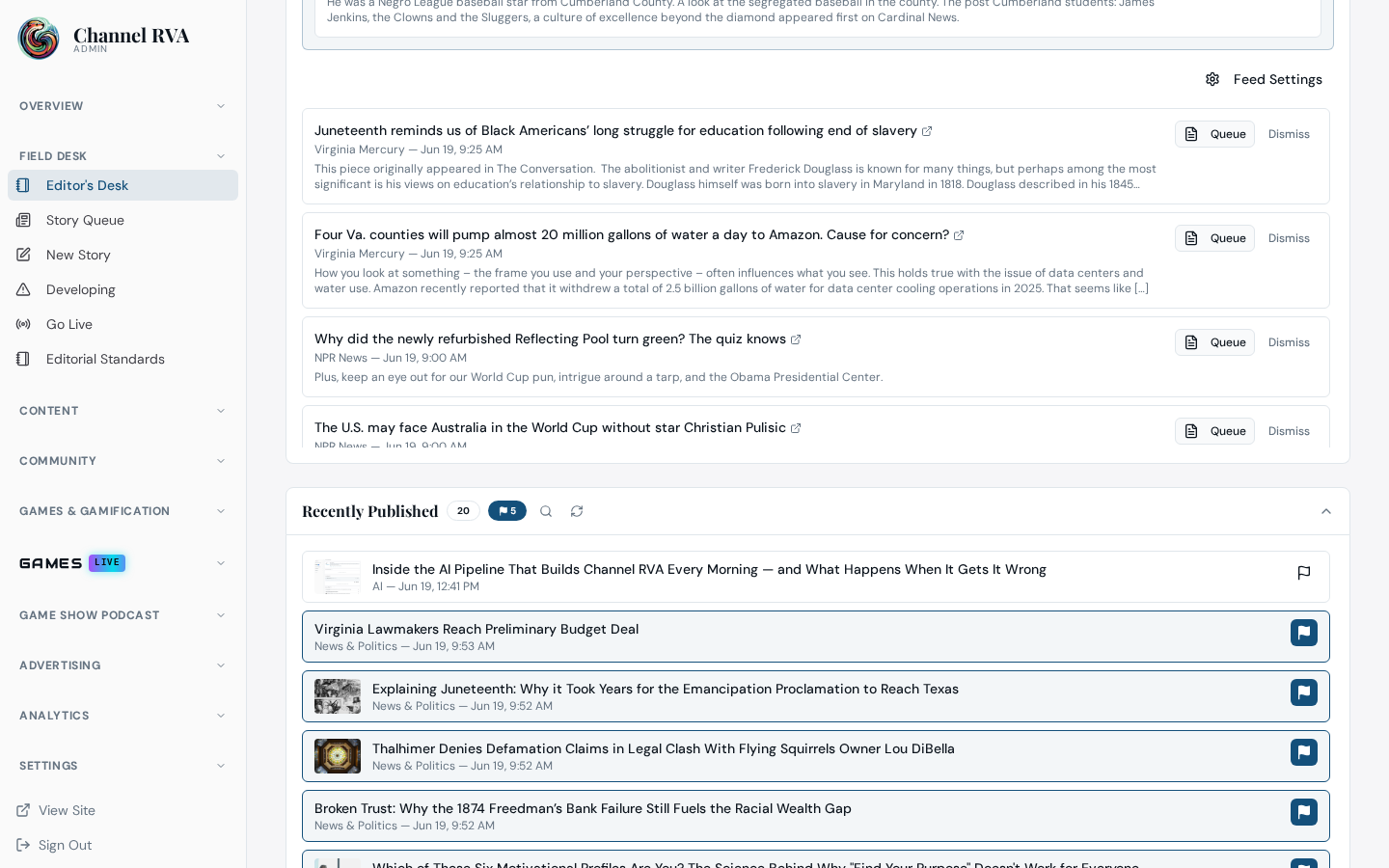
The whole thing returns to me for a final editorial review before it goes live.
Why the Hallucination Keeps Happening Anyway
Language models are trained on datasets that reflect reality as it existed when the data was collected. A governor who held office for four years — referenced in thousands of articles, cited in legislation, embedded everywhere — becomes deeply wired into a model's association between "Virginia" and "governor." The model doesn't naturally know the office changed hands. It reaches for the name it knows.
I've intervened in this pipeline multiple times specifically to fight this problem. The fact-check registry flags any mention of Youngkin in a context implying current office and any active-verb construction with his name. A scrubbing function runs after every dossier is assembled, stripping hallucination-prone official names that don't appear in the source material. Today I added the submission gate — the hard block that prevents publication when an error-severity violation is detected. Had it been in place this morning, the article wouldn't have made it out. I would have seen the error, been forced to address it, and it never would have reached your inbox.
And yet here we are. Which led me to a different question: is the model doing the writing actually the right tool for this job?
Changing the Writer
The Field Desk writer has been running on Gemini 2.5 Flash — a model I don't use for writing. When I thought about why the hallucination keeps slipping through, that stood out. Gemini 2.5 Flash powers Google's AI Overviews, which have a well-documented hallucination problem. It's not a model I would choose for this.
For my own writing — outside of the content engineering software we've built at Xponent21 — I use Claude almost exclusively. I moved away from ChatGPT a while back because the model quality degraded and it stopped being a reliable writing partner. Claude became the default.
So why test GPT-5 now instead of going straight to Claude? It comes down to how Channel RVA is built. The platform runs on Lovable, which has native integrations with both Gemini and OpenAI. Plugging in GPT-5 is relatively straightforward. Connecting the Anthropic API requires using my own key, which adds a layer of complexity — spend happens in two places, and it takes more time to wire up correctly. GPT-5 is a newer model, and I've heard enough people say it's meaningfully better than the ChatGPT versions I gave up on that it was worth trying before doing the heavier integration lift.
I've run it on a few articles. The early results seem okay. But "okay" isn't the bar — the bar is whether Youngkin's name stops appearing in stories that have nothing to do with him. I won't know that until I've put several more editions through the system and seen how the model handles Virginia political context when the source material doesn't mention it.
If GPT-5 doesn't hold the line, I'll wire up the Anthropic API and switch the writer to Claude. The rules are solid. At this point, it's a question of finding the model disciplined enough to follow them.
That's the thing about building on top of AI: you can engineer around a lot of failure modes. But at some point you're trusting a model to behave the way you've told it to, and that trust has to be earned over time, edition by edition. I'll keep building, keep testing, and keep telling you when something breaks.
— Will Melton, Editor, Channel RVA