Of The Trees Turns a D.C. Warehouse Into an Immersive Bass Experience—With Richmond Built Into the Formula
By Kayla Putman · June 8, 2026 · 5 min read read
Category: Music
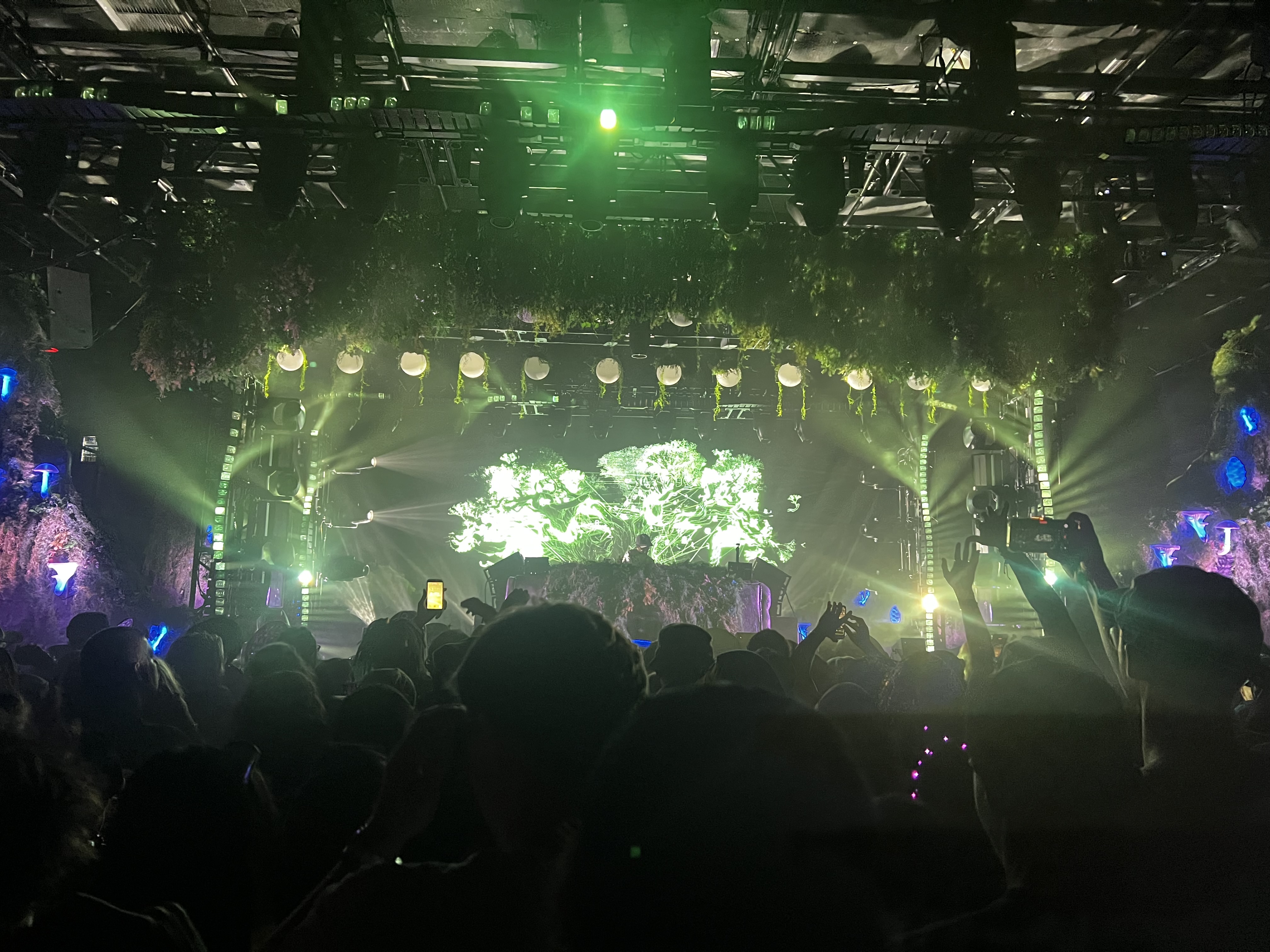
Of The Trees’ Moonglade Park tour stop in D.C. turned a warehouse show into an immersive, multi-room experience that blended music, art installations, and environmental storytelling. Richmond’s Rhythm City Collective also curated its own space inside the venue, highlighting a growing shift toward more collaborative, experience-driven electronic music events.
WASHINGTON, D.C. — Summer festival season may dominate the headlines, but some of the most interesting developments in bass music are happening away from festival grounds entirely.
On June 5, Of The Trees brought his Moonglade Park tour to Bertha, a warehouse venue tucked into Northeast Washington that served as an appropriate setting for a project built around atmosphere, environmental storytelling and community engagement. The evening combined immersive venue design, carefully curated support programming and a concept-driven production approach that extended well beyond the stage itself.
The architect behind it all is Tyler Coombs, known professionally as Of The Trees. Since the release of Moonglade Park, Coombs has expanded the album beyond a collection of songs into a broader experiential framework. Each stop on the tour has been paired with guided nature walks through nearby parks and outdoor spaces, reinforcing the themes that run throughout the record while creating a point of connection between audience and environment before attendees even arrive at the venue.
It is a simple concept, but one that reflects a growing shift within electronic music. As ticket prices continue to rise and audiences become more selective about where they spend their time and money, artists are increasingly tasked with delivering experiences that feel cohesive rather than merely impressive.
The Washington stop offered perhaps the clearest example of that philosophy in practice.
The most notable addition arrived a week before the show, when Richmond's Rhythm City Collective announced a curated lineup featuring Whereami, Air Castles, Actual Garbage, Radiant, Tendrils and Frush. Initially, the announcement appeared to be a standard support package.
What emerged was something considerably more substantial.
Rather than opening the main room, Rhythm City Collective was given an entirely separate space within the venue to program throughout the evening. The collective's visual identity was integrated into the broader Moonglade Park rollout, creating a parallel experience that operated alongside the tour rather than beneath it.
For attendees, the result was effectively two events occupying the same footprint. One room hosted a national touring production led by one of bass music's most recognizable names. The other showcased a Richmond collective that has spent the past several years steadily expanding its presence throughout the Mid-Atlantic underground.
That distinction matters.
Touring productions frequently incorporate local support, but rarely do they hand over physical space, programming authority and creative autonomy in the way Rhythm City Collective was afforded here. The arrangement positioned the collective as a collaborator rather than an opening act, a subtle but meaningful difference that elevated the role Richmond played in the overall experience.
The venue itself reinforced that sense of intentional design.
Bertha does not function like a traditional concert venue. The approach begins before guests enter the building. Tucked within an industrial corridor, the space reveals itself gradually, leading attendees through a themed ranger station installation before opening into a maze of projection mapping, sculptural environments, suspended moss features and hidden audio elements distributed throughout the warehouse.
The design encourages movement. Rather than directing attention toward a single focal point, the venue rewards exploration. A functioning hearse doubles as an interactive installation. Suspended cloud structures conceal speakers within their framework. Elevated platforms, swings and lounge areas create multiple vantage points from which to experience the event.
The effect is not sensory overload so much as sensory redistribution. Every room offers a different perspective on the same production, making movement through the space part of the evening rather than a distraction from it.
That philosophy extends directly into Bertha's sound design.
Unlike conventional venues where audio is concentrated around a stage, sound at Bertha feels embedded within the architecture itself. Low frequencies travel through hallways, installation spaces and gathering areas, producing noticeably different listening experiences depending on where attendees choose to spend their time.
When Of The Trees eventually took the stage, the production felt like a continuation of the environment that had already been established rather than a separate spectacle layered on top of it. Moss-covered scenic elements, bioluminescent imagery and environmental visuals mirrored themes present throughout Moonglade Park without overwhelming the music itself.
The evening's progression reflected a similar level of consideration.
Coverage throughout the night shifted between the RCC-curated Bette stage and the main Bertha stage, where Jade Cicada delivered one of the evening's most technically compelling performances before the transition into Of The Trees' headlining set. Rather than feeling segmented, the programming unfolded as a gradual progression across rooms, genres and energy levels.
What made the Washington stop particularly interesting was not the scale of the production. Large-scale electronic events are increasingly common. Instead, it was the consistency of vision connecting each element of the experience.
The venue design reflected the album's themes. The pre-show nature walks reflected the album's themes. Even the inclusion of Rhythm City Collective felt aligned with a broader emphasis on community, place and regional culture.
For Rhythm City Collective, the night represented another opportunity to introduce Richmond artists to a wider audience within one of bass music's most visible touring productions. For Of The Trees, it demonstrated how thoughtful curation can transform a tour stop into something that feels more deliberate and memorable than a standard concert experience.
At a time when audiences have more entertainment options than ever competing for their attention, that level of intentionality may be the most valuable production element of all.