What Richmond Needs to Know Before it Becomes the Next Data Center Capital
By Courtney Turrin · May 21, 2026 · 18 min read read
Category: Business & Economy
Tags: AI, Data Centers
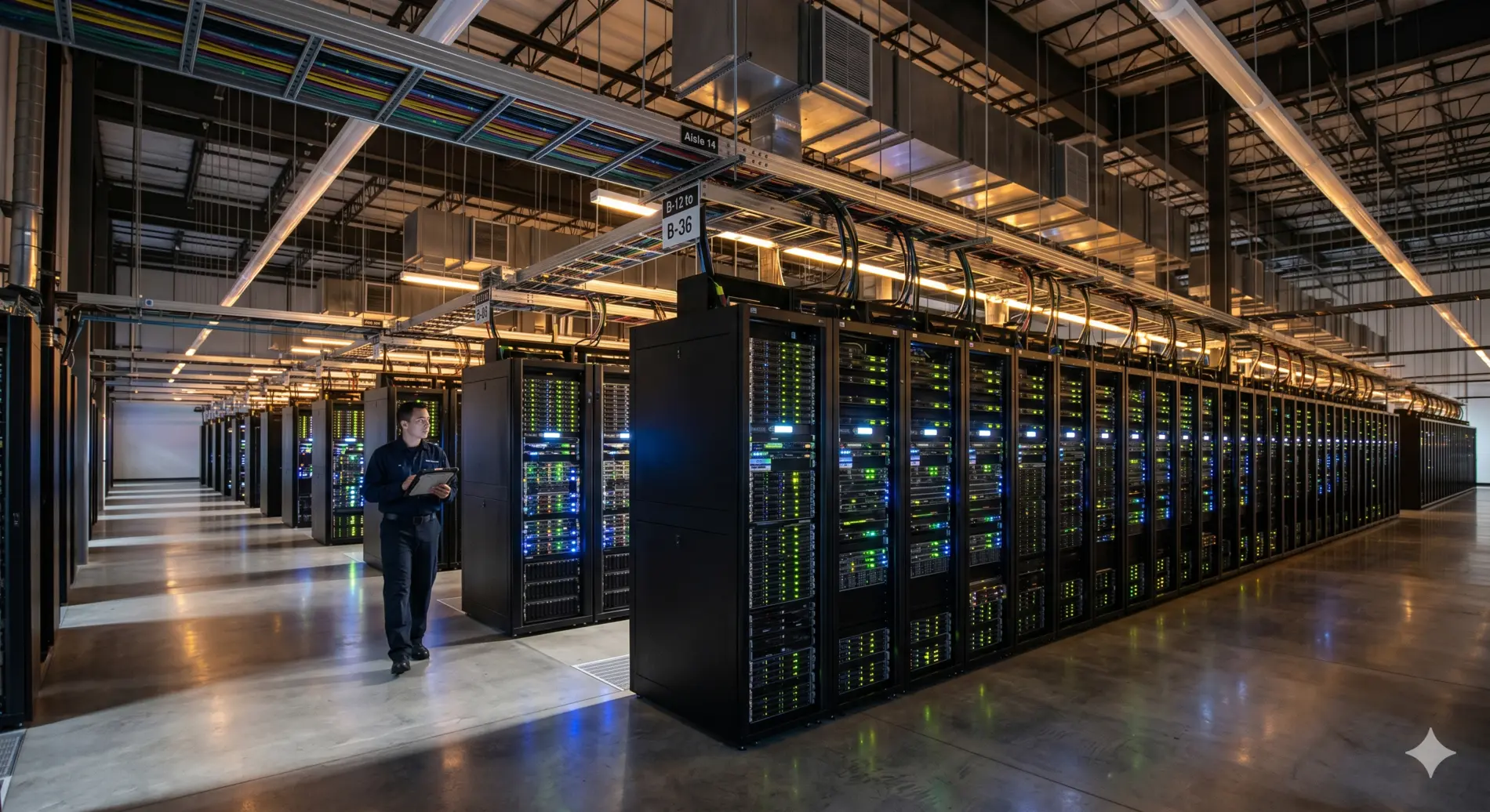
Richmond's data center inventory grew sevenfold in the first half of 2025. The decisions being made in county boardrooms right now will shape this region for decades. Here is what the data shows about what communities get and what they give up.
Richmond wasn't supposed to be in this conversation yet.
For years, the data center debate belonged to Northern Virginia: to Loudoun County and its "Data Center Alley," to Ashburn, to the counties just outside Washington where, according to the data center industry, roughly 70% of the world's internet traffic flows through a handful of square miles. That's where the fights over electric bills, water use, and diesel exhaust were happening. That's where residents were showing up to county board meetings in the hundreds. That was someone else's problem. (Figure 1)
[datawidget key="global-traffic-share"]
Then, in the first six months of 2025, the Richmond area's data center inventory increased more than sevenfold, surpassing Dallas/Fort Worth, the second-ranked market in the country, by nearly double. Google has active or approved projects in Chesterfield County. Meta and QTS already operate in Henrico. EdgeCore announced a planned $17 billion campus in Louisa County. CleanArc announced a $3 billion campus in Caroline County. Powhatan County approved a $2.7 billion campus in late 2024. Goochland's board voted after midnight to approve a technology overlay district, opening the door to more. (Figure 2)
[datawidget key="central-va-projects"]
The wave that took decades to build in Northern Virginia arrived in Central Virginia almost overnight.
Before your locality's board of supervisors takes its next vote, here is what the data actually shows about what communities get, and what they give up, when a data center moves in.
The Promise: Taxes, Jobs, and Economic Activity
State and local officials who champion data centers point to real numbers. The industry pays real estate and business property taxes to the localities where its facilities sit, and those revenues are substantial. In Loudoun County alone, according to JLARC, data centers are assessed on roughly $17.3 billion worth of personal property and $42 billion in land value. The fiscal ratio in Loudoun runs approximately $26 in tax revenue for every dollar of local services data centers consume, an extraordinary return compared to a manufacturing plant, which typically generates a 4:1 ratio. (Figure 3)
[datawidget key="loudoun-tax-base"]
Virginia has worked hard for this position. Since 2010, the state has offered a sales and use tax exemption on data center equipment, including servers, cooling systems, generators, substations, and cabling, making it one of the most attractive markets in the country for the industry. The exemption was designed as an economic development tool after the 2008 housing crisis and initially forecast to cost $1.5 million annually in forgone revenue.
That estimate proved wrong. The exemption now costs Virginia more than $1 billion per year. Forgone state revenue jumped from $685 million in fiscal year 2023 to $1.02 billion in fiscal year 2024, nearly a 50% increase in a single year. In fiscal year 2025, Virginia missed more than $1.6 billion in tax revenue due to the exemption alone, a figure 118% higher than the prior year. In fiscal year 2024, that one exemption accounted for nearly 80% of all of Virginia's economic development incentive spending. Over the past decade, data centers have been exempted from paying $2.7 billion in sales and use taxes, 11 times more than the next largest state incentive program. JLARC concluded that the state loses 52 cents on every dollar it abates for data centers. (Figures 4 and 5)
[datawidget key="tax-exemption-growth"] [datawidget key="incentive-share"]
The industry disputes this math. The Northern Virginia Technology Council, whose 2026 report was commissioned by the industry and sponsored in part by Dominion Energy, claims data centers contribute more than $1.5 billion annually in Virginia state tax revenue even after the exemption, and more than $2 billion in local government revenue in Northern Virginia alone. That analysis was produced by an economics firm hired by the industry and has not been independently validated. It also does not account for the rate increases, grid costs, and environmental externalities detailed below.
The jobs picture is similarly complicated. The industry claims to support 74,000 jobs across Virginia, a figure that includes construction workers, supply chain workers, and other indirect employment. JLARC found approximately 9,395 direct data center jobs statewide. A typical 250,000-square-foot data center employs roughly 50 full-time workers, about half of them contractors. Construction crews build the facility and move on. The permanent workforce is a fraction of what the headline job numbers suggest. (Figure 6)
[datawidget key="industry-vs-jlarc-jobs"]
The forgone tax revenue has a direct impact on the services Virginians use. Good Jobs First, a nonprofit that tracks corporate subsidies, calculated that the fiscal year 2024 exemption loss equals approximately $212 per public school student statewide. That is not a Northern Virginia school funding problem. It is a Richmond City, Chesterfield, and Henrico problem too.
It is also worth considering the broader fiscal context before accepting the premise that Virginia needs this industry badly enough to absorb these costs. Virginia entered the data center boom already in strong financial shape; the state has posted surpluses for four consecutive years, ended fiscal year 2025 with a $2.7 billion surplus and a $4.7 billion rainy day fund, and holds AAA bond ratings from all three major credit agencies, a distinction fewer than a dozen states can claim. Virginia's own House Appropriations Committee Chair said during the broader 2026 budget debate that the state has "the resources to address the needs" without major tax increases. The data center industry does contribute tax revenue, and in some localities that revenue is substantial. But the fiscal record raises a reasonable question: was there a gap in Virginia's finances that required accepting higher utility bills, new fossil fuel infrastructure, degraded air quality, strained water supplies, and lost school funding as the price of admission? (Figure 7)
[datawidget key="state-fiscal-context"]
Your Electric Bill
Data centers require enormous, continuous amounts of electricity. A conventional hyperscale facility, the kind now being approved across Central Virginia, can consume as much power as 100,000 average households, according to the International Energy Agency. When a data center connects to the grid, the utility must build or upgrade transmission lines, substations, and generation capacity to serve it. Under the way utility regulation has always worked in America, those infrastructure costs are socialized across all ratepayers, regardless of where in the state they live. (Figure 8)
[datawidget key="household-power-equivalent"]
Virginia's State Corporation Commission approved a Dominion Energy rate increase in November 2025 adding $16 per month to the typical residential bill, with commissioners noting the challenges posed by data center growth were "not seen in decades, if ever." That rate increase applies to every Dominion customer in Virginia.
Dominion Energy CEO Bob Blue told investors in February 2026 that "affordability is essential" even as the company reported its data center pipeline had grown to more than 48 gigawatts under contract, and that all 20 of Dominion's peak demand days on record had occurred in the preceding 14 months. (Figure 9)
[datawidget key="dominion-demand-pipeline"]
JLARC's independent analysis projects that a typical Dominion residential customer could see generation and transmission costs increase by an estimated $14 to $37 per month by 2040, driven primarily by data center demand. One consumer advocacy group, drawing on the same research, put the figure at up to $444 per year. (Figure 10)
[datawidget key="monthly-bill-impacts"]
The grid pressure is already visible in wholesale electricity markets. AI data center demand contributed to an 833% increase in a key regional capacity auction price in a single year. Virginia's energy demand is projected to rise 183% by 2040, almost entirely driven by data centers. (Figure 11)
[datawidget key="grid-price-demand-spike"]
There is ongoing legislative effort to address the rate question. A 2026 Virginia Senate bill proposed shifting more infrastructure costs back onto data centers, which the State Corporation Commission (SCC) projected would reduce residential bills by roughly $5.52 per month while increasing data center rates by 15.8%. That bill has not passed. A new data center rate class taking effect in January 2027 will require large-load customers to meet minimum demand charges. This is a step forward, though consumer advocates note it addresses future growth more than the existing cost backlog.
None of this is the result of Richmond-area residents deciding to use more electricity. It is the cost of being the host state for the world's most energy-intensive industry during the most aggressive infrastructure buildout that industry has ever undertaken.
The Gas Plant Problem
To meet surging data center demand, Dominion Energy's most recent long-range plan calls for building six new natural gas power plants. The first is already approved: the Chesterfield Energy Reliability Center, a 944-megawatt facility to be built on the site of the former Chesterfield Power Station south of Richmond, with a construction cost estimated at $1.47 billion. Based on Dominion's own estimates, including fuel costs and utility revenue requirements over the plant's lifespan, the Southern Environmental Law Center and other groups that reviewed the SCC filing put the total cost to ratepayers at up to $8 billion. That cost will be recovered through customer bills over the plant's 30-plus year operating life. (Figure 12)
[datawidget key="gas-plant-costs"]
Natural gas plants are not short-term infrastructure. A facility approved today will be burning fuel and generating emissions in 2055. Virginia ratepayers will be financing it the entire time.
This creates a direct collision with Virginia's own law. The Virginia Clean Economy Act (VCEA) of 2020 legally commits the state to 100% carbon-free electricity by 2045. In its long-range planning filings, Dominion stated that meeting data center demand while fully complying with the VCEA using renewables alone is not viable under current conditions. The practical result is that an industry boom driven by private companies is forcing the state to choose between its legal climate commitments and grid reliability, and the gas plants indicate which way that choice is going.
The tech companies building these facilities are not silent on the environment. Google, Microsoft, Meta, and Amazon have all made high-profile pledges to be carbon neutral or powered by renewable energy. Those pledges typically involve purchasing renewable energy credits, financial instruments tied to clean energy production somewhere on the grid, rather than directly powering Virginia data centers with clean energy. The distinction matters. Buying a renewable energy credit does not change what power plant runs when a server draws electricity at 2 a.m. in Chesterfield County. In Virginia, where 54% of electricity currently comes from natural gas and 4% from coal, the electrons powering these facilities are predominantly fossil-fueled, regardless of what a corporate sustainability report says. (Figure 13)
[datawidget key="vcea-vs-fossil-mix"]
Virginia is being asked to lock in fossil fuel infrastructure for 30 years to power an industry whose companies are simultaneously marketing themselves as clean. The people who will pay for that gap, in utility bills, in carbon emissions, and in the state's ability to meet its own climate law, are Virginia residents.
Who Pays for the AI You Use?
This is worth understanding, because the common assumption, which is that people paying for AI tools are covering the energy those tools consume, does not match the financial reality of the industry right now.
When a user in California sends a query to ChatGPT or Claude, that query travels to a data center and consumes compute and electricity. The data center is almost certainly in Virginia or another state that has attracted this infrastructure. The California user pays their subscription fee. The Virginia ratepayer pays for the grid that made the query possible.
But there is a more fundamental issue: AI companies are not charging what their services actually cost. In January 2025, OpenAI CEO Sam Altman posted on X: "Insane thing: we are currently losing money on OpenAI Pro subscriptions! People use it much more than we expected." He added: "I personally chose the price and thought we would make some money." According to financial documents reported by the Wall Street Journal, OpenAI spent approximately $1.69 for every dollar of revenue it generated in 2025 and projects $25 billion in cash burn in 2026. These are not transitional growing pains. They are the deliberate financial structure of an industry racing to capture users before prices reflect actual costs. (Figure 14)
[datawidget key="openai-cost-gap"]
The pattern has precedent in the technology industry. Services are introduced cheaply or free, adoption is normalized, dependency grows, and pricing eventually adjusts. OpenAI's internal documents have reportedly included projections of subscription price increases over several years. Industry analysts expect meaningful price increases within the next one to two years as venture capital funding discipline tightens.
When prices eventually reflect true costs, those costs will include the energy bills, grid upgrades, and environmental externalities that Virginia residents have been absorbing. The person in California will eventually pay more for their subscription. The person in Chesterfield County will have already paid for years in their utility bill, in their forgone tax base, and in their environmental degradation.
Land: What Gets Built Stays Built
A data center campus is not a reversible decision.
The facilities being approved across Central Virginia, some spanning hundreds of acres and a few approaching or exceeding 2,000 acres, require cleared, graded, paved, and hardscaped land. Farmland becomes an industrial campus. Forest becomes concrete. Data from the Piedmont Environmental Council shows that existing data centers in Northern Virginia already occupy about 6,200 acres, with proposed projects set to add nearly 21,000 more acres, more than tripling the current footprint in Northern Virginia alone. (Figure 15)
[datawidget key="land-footprint-expansion"]
Central Virginia is on a similar trajectory. Proposed campuses in Pittsylvania, Louisa, Caroline, and Chesterfield counties collectively span thousands of acres, much of it agricultural or undeveloped land. Once developed, the ecological function that land served in supporting groundwater recharge, carbon sequestration, wildlife habitat, and agricultural production is gone. It does not return when servers are decommissioned or when a company consolidates operations elsewhere.
Efficiency improvements in AI hardware are real and ongoing. Newer chips generate less heat per computation, which reduces cooling and energy demand per unit of work. Some analysts argue this will moderate data center growth faster than current projections suggest. That may prove true. But even the most optimistic efficiency scenarios do not un-convert land. The gas plants approved to power this buildout will run for 30 years. The soil under a paved campus does not recover on a human timescale. The decisions being made in county boardrooms right now are effectively permanent.
Water
Data centers are significant consumers of water, primarily for cooling server equipment that generates intense heat around the clock.
According to the MOST Policy Initiative, a medium-sized data center can consume up to roughly 110 million gallons of water per year, the equivalent annual usage of approximately 1,000 households. Larger hyperscale facilities can consume up to 5 million gallons per day, equivalent to the water use of a town of 10,000 to 50,000 people. A 2026 Frontiers in Climate article reports that Northern Virginia's data centers collectively consumed close to 2 billion gallons of water in 2023, a 63% increase from 2019. Approximately 80% of the water drawn for cooling evaporates in the process and is not returned to the local water system. (Figure 16)
[datawidget key="water-use-scale"]
Nationally, U.S. data centers directly consumed an estimated 17.4 billion gallons of water in 2023, a figure projected to increase to between 38 and 73 billion gallons by 2028, with newer AI-focused hyperscale facilities expected to account for half of that consumption. (Figure 17)
[datawidget key="national-water-projection"]
Some companies have made commitments to closed-loop cooling systems, which recirculate water rather than evaporating it, and to immersion cooling technologies that require substantially less water. These approaches exist and some facilities use them. However, they cost more upfront, and mandatory disclosure of cooling technology and water use projections is not currently required in Virginia for project approval. JLARC has recommended that local governments be expressly authorized to require water use estimates as part of the approval process. Until that changes, communities evaluating proposals largely have to take developers at their word.
Heat
A study published in March 2026 by researchers at the University of Cambridge examined land surface temperature data from more than 6,000 data centers worldwide over a 20-year period. They found that land surface temperature increased by an average of 2 degrees Celsius (3.6 degrees Fahrenheit) in areas surrounding AI data centers after operations began, with some locations recording increases of up to 9 degrees Celsius (16.2 degrees Fahrenheit). The thermal impact extended up to 6.2 miles from the facility itself, a radius that, depending on where a facility is sited, can easily encompass schools, neighborhoods, and parks. (Figure 18)
[datawidget key="heat-island-radius"]
The study is a preprint, meaning it has not yet completed formal peer review. Researchers debate whether the temperature increase stems primarily from the heat output of the servers themselves or from the clearing of vegetation and replacement with hardscaped surfaces, a well-documented driver of local warming. Both are direct consequences of building a data center, so for communities evaluating a proposal, the distinction changes nothing about the practical outcome.
Air Quality
Backup power is a standard feature of every data center. Because servers must run continuously and cannot tolerate even brief power interruptions, data centers maintain large banks of diesel generators capable of powering the entire facility during an outage. These generators are also run on a regular testing schedule.
Virginia Commonwealth University published research in early 2026 finding that in Northern Virginia, emissions from data center backup generators between 2015 and 2023 increased substantially: carbon monoxide emissions rose 196%, nitrous oxide emissions rose 111%, and dangerous particulate matter emissions jumped 139%. In some cases, the total air pollution output from a cluster of data centers exceeded that of a nearby natural gas power plant. (Figure 19)
[datawidget key="backup-generator-emissions"]
The core issue is the fuel. Diesel backup generators can release 200 to 600 times more nitrogen oxides per unit of energy produced than a natural gas plant. Nitrogen oxides contribute to smog formation and are linked to respiratory disease, cardiovascular conditions, and elevated asthma rates, particularly in children and the elderly. A 2024 study by researchers at Caltech and UC Riverside estimated that data center air pollution caused approximately $6 billion in public health damages nationally in 2023.
Virginia's Department of Environmental Quality permits these generators to run up to 500 hours per year, equating to roughly 1.4 hours per day. The state has approved 8,910 generators for Virginia data centers, nearly all of them lower-standard Tier 2 models. Data centers often arrive in communities with non-disclosure agreements in place that limit what is publicly known about a project before approval. (Figure 20)
[datawidget key="generator-permit-scale"]
For Central Virginia localities where data centers are being proposed near subdivisions, schools, or daycares, a scenario which has already occurred in Henrico, the generator question is among the most immediate public health considerations to raise in public hearings.
Noise and Electronic Waste
Two additional impacts that rarely lead the conversation but matter to communities living adjacent to these facilities:
Noise Pollution
Data centers run 24 hours a day, seven days a week. The cooling systems, generators, and HVAC equipment produce a continuous low-frequency hum that residents in Prince William County have described as audible through walls, across backyards, and throughout the night. JLARC found that data centers are broadly incompatible with residential uses due to constant industrial noise. The Sierra Club's Virginia chapter recommends that backup generators and HVAC equipment be set back at least 500 feet from adjacent residences.
Electronic Waste
Data center servers are replaced every three to five years. A large facility houses thousands of them. JLARC's 2024 report found Virginia's regulation of electronic waste largely unaddressed in state policy. The environmental footprint of this equipment does not end when a server is decommissioned.
The Bigger Picture for Richmond
Richmond and its surrounding counties are not yet Loudoun County. The density is lower, the facilities are newer, and there is still time to establish expectations before the next wave of approvals. Northern Virginia is a preview of what happens when that window closes.
Some Central Virginia localities are already responding. Henrico County voted unanimously in June 2025 to require individual public hearings and supervisory approval for all new hyperscale data center proposals after supervisors recognized the pace of what was coming. Hanover County rejected a proposal in December 2024, and Charles City County saw a developer withdraw its application after significant community opposition. Other counties, by contrast, have approved projects with limited public process or created zoning frameworks designed specifically to attract more.
Residents and local officials in communities navigating these decisions have found the following questions worth putting to developers and county boards before any vote:
What are the estimated annual water withdrawal figures, and what cooling technology will be used?
What generator models are proposed, and will the facility commit to emissions capture technology?
What grid infrastructure costs will the developer bear directly, and what will be socialized to ratepayers?
How many permanent full-time employees will the facility support at full operation?
What local tax revenue will the facility generate, and over what timeline?
What renewable energy commitments is the developer making, and are they contractually binding?
What noise mitigation measures will be required, and how will compliance be enforced?
What happens to the land, the infrastructure, and the ratepayer obligations if the company changes its plans?
Much of the infrastructure built to serve anticipated data center demand, including transmission lines, substations, and new gas plants, will remain on the grid for 30 years or more. If the AI buildout slows, if major tenants consolidate, or if more efficient technology reduces demand faster than projected, Virginia ratepayers could spend decades paying for infrastructure that serves facilities that no longer need it.
Virginia's General Assembly is actively debating these issues. Legislation requiring impact studies prior to approval has been introduced. The sales and use tax exemption that has cost the state more than $2.7 billion over the past decade is under serious scrutiny, with its 2035 expiration now a live political question. Consumer protection measures around rate increases are advancing, though slowly.
The outcome of those debates will be shaped in part by whether communities in Central Virginia are engaged and whether the full scope of those trade-offs is part of the public record before any vote is taken.